Friday, May 5, 2006

Finally, a new post. I am back in Podgorica after spending time in Serbia for workshops and a conference in the U.S. and yes, a quick family visit. My time in Montenegro is coming to a quick end. The semester at the University of Montenegro is almost over....the last lectures will be this coming week. I don't get to/have to give a final exam because my class was an optional elective for students--because it was taught in English. I regret that my teaching assignment was approached rather haphazardly by the Political Sci/Journalism Department. While I have enjoyed my time in Montenegro, the teaching assignment would have been more fulfilling for the students and me if the department had acted more responsibily. Oh well...or as a Montenegrin friend would say, "That is our reality."

-0-
I have sent a questionnaire to the Secretary General of Parliament to attempt to collect some data from Members of Parliament about press freedom and responsibility. There are only 78 or 79 MPs....we'll see how the survey goes.

-0-
What would you do if your state in the U.S. were to decide to take a vote for independence from the U.S.? The last there were independence efforts by states, the U.S. fought a civil war. That is part of what happended in old Yugoslavia. In a couple of weeks, Montenegrins will vote on whether to end their relationship with Serbia--and become independent. If they support independence, it will be an absolute, final end to old Yugoslavia. Other parts--Croatia, Slovenia, Bosnia and Macedonia--are already independent.

-0-
Friends, who initially thought the independence initiative would not pass, are now saying it will pass. We will see.

-0-
If you moved to Montenegro from Serbia 10 years ago, are you Serbian or Montenegrin or??? Or, suppose you moved from sleepy Podgorica to the big city of Belgrade six or eight years ago to take a job. Are you Montenegrin or Serbian? If you were born in Podgorica in 1955 or 1960, from parents who trace their family history to northern Serbia, are you a Yugoslavian, Serbian or Montenegrin? The point I am struggling to make is that family and regional history makes the independence question murky...there are even splits of opinion on the independence issue in families. And no, there are no rumblings of a civil war over the independence issue.

-0-
Lost connections: I met a fellow in Belgrade whose grandmother was born in the U.S. but married a Serb and they moved to Belgrade in the early 1930s. Her children could/should have had U.S. citizenship rights--as would their children. But, the citizenship was never sought because of World War II and then the communist government in Yugoslavia. The grandmother is dead, the son is dead....and I have met only the grandson who laments on the loss of a life he might have had, if U.S. citizenship could have been established.

Meanwhile, back at the ranch....I take my citizenship for granted. I was lucky enough to have been born in the U.S. because my ancestors pursued life in a new country. In the future, I should never complain about paying taxes....and I should make certain that I vote in every election. How lucky I am.

-0-
I have lost my only English news channel. BBC changed its satellite distribution from an analog channel to a digital channel and apparently the cable company has not kept up with the change. The space BBC once occupied is now static. Who will set my news agenda? What will I think about? Will I watch DVDs for the sort of "visual stimulation and companionship" often provided by television? Or, maybe I will just read more. I will keep you posted.

-0-
The swallows have returned and are building new mud nests on my patio. I'd be willing to bet that they migrated here from Northern Africa....did they bring bird flu? Not that I am aware. I have heard no reports in the news....of course, my BBC channel is no longer available. :)

-0-
“You must be nuts traveling to all those foreign places,” some of my friends an acquaintances think. But let’s look at the facts. Rank the following countries according to their risk of threat from terror attacks, from one (low risk) to five (high risk). I have visited all of these places.
____ United States

____ Serbia & Montenegro

____ Albania

____ Uganda

____ Germany

The information in this quiz comes from Aon Crisis Management and was reported in Wired magazine, June 2005, pages 56-57.

The greatest terror threat risk comes in Uganda. The article doesn’t report specifics but I suspect this risk is primarily in the northern part of the country, bordering Sudan, and the threat comes from the Lord’s Resistance Army, a violent group that has, for more than a dozen years, kidnapped children to turn them into child soldiers or slaves. (Participants in workshop I helped with, in safe Kampala a year ago, were talking about a radio station in the north of the country that was destroyed by rebels. They marveled at the fact that the rebels didn’t shoot the announcer on duty at the time, instead letting him go before they burned the control room.)

There is a three-way tie next between Germany, the United States and Serbia & Montenegro—all belong in the elevated threat category. Germany and the U.S. are at risk from far right and Islamic extremists. Serbia & Montenegro have some risks from nationalists/separatists and organized crime violence. The safest country on the list, Albania, is in the guarded category. One of my favorite countries—Zambia—is in the low threat level.

-0-
Friends in Nis, Serbia, were asking about my travels. I told them that I barely travel anywhere compared with my friend Sam, who travels 5-6 time a year. They were not impressed though when I told them about the guard who traveled with him in Angola, 5-6 years ago. The guard's primary job was to watch the vehicle when it was parked to ensure that no one planted a bomb under it.

Why did the story have no impact on them? Because they live only 3 hours from Kosovo....where violence still raises its ugly head.

When was the last time you read anything in a U.S. newspaper about Kosovo? For many journalists, it is old news....there is "fresh" violence to report in Iraq.

Wednesday, April 19, 2006

Foot traffic. When you don’t have the tradition of automobile ownership, the arrival of private car ownership creates some challenges. I’ve mentioned the parking issue—there are few organized parking lots and people routinely park on sidewalks, right in the way of pedestrians.

There’s no driver’s ed program in the schools so learning to drive often means enrolling in a private driving school. Driving is chaotic but I often think that people are actually better drivers because of the chaos—the potential dangers cause drivers to be even more watchful. Driver manners vary considerably as well, causing pedestrians to be ever watchful as they cross the streets or walk along the right-of-way.

Foot traffic also means the downtowns have not dried up as have those areas in U.S. cities. (A friend of mine, visiting the U.S. on an exchange program, was surprised by how dead Kansas City's downtown was when he visited the city.)


Here’s a shot of the pedestrian plaza in Nis. The shot was taken at about 4 PM from the balcony of Miedia Center Nis. Traffic will actually increase substantially after 5 PM as people come out to shop, window shop, and socialize. I’ve seen this same scene in Belgrade and Podgorica and Tirana, Albania. The charm of the evening walk is one of the things that attracted me to Podgorica. Some people, right after work, take an afternoon nap to ensure enough energy to enjoy the evening out and it is not unusual to see the plaza busy on a weeknight until midnight. My American habit, of early to bed and early to rise, make it hard for me to take the afternoon nap but a cup of coffee or espresso around 3 or 4 PM gives me a boost to help me stay up at least until 9 or 10 PM. Many of the coffee shops also have tents or awnings that offer protection from the summer sun or a spring shower.

Another feature of the foot traffic is the abundance of small kiosks that sell newspapers, snacks, magazines and cigarettes. This is the primary sales outlet for newspapers. They're stacked horizontally across the front of the stand. There actually is someone inside the stand to collect money.
-0-

A note about Big Brother. It is not, to my knowledge, a co-production with anyone in Bosnia or anywhere else. It's my understanding that B-92 is pursuing the Big Brother project by itself. The move to license national networks is part of a broader effort to decrease the total number of television stations--a source told me a couple of days ago that there are about 300 stations in Serbia--including municipal and private stations. There was a description a few years ago, that I had forgotten, that referred to car wash and garage stations. These were literally small time stations that might have been put on the air by the owner of a very small business. These stations often had few legitimate local programming efforts other than perhaps going to the local video store to rent a movie for airing.

By the way....need a copy of an Oscar winning movie that's not yet available on DVD? You can find it on the streets of Nis. Walk the Line and Brokeback Mountain are both here for about $2.20 each.

Monday, April 17, 2006

Thank goodness for Phillip Morris. I don't smoke and have even called cigarette manufacturers merchants of death but Phillip Morris has been a welcomed addition to the city of Nis (pronounced like Kneesh). About 2-3 years ago they purchased a failing government cigarette plant, employing more than 2,200 people; they paid about $1 billion for the facility. Today, between 1,200-1,300 people work at the plant. They make Marlboro and Marlboro Lights for domestic and export consumption plus make some other domestic brands.

My hotel--though not built exclusively to cater to Phillip Morris--offers great service in part because of that market. I'm staying at Hotel Panorama Lux Garni. As the name suggests, they're on a hillside, overlooking the city.

Today, I start another management and sales workshop, this one at Media Center Nis, an NGO founded to offer media training and press support, including a work center/support facility for local reporters and a place for press conferences. They are similar to Montenegro Media Institute.

I like Nis. The city has struggled greatly with unemployment--not only did the tobacco plant close but a big appliance manufacturer--state owned and employing about 4,000 people--has closed and there's little reason to believe it will reopen to make stoves, TVs and washing machines. The people, at least the media people I've met, work pretty hard, are ambitious, and are nice--and that is something I should not always expect. Nis was the location of "collateral damage" during the NATO bombings. Let me be specific: a U.S. plane, armed with cluster bombs, mistakenly dropped its ordinance on civilians at a vegetable market, killing 4 or 5 people. All sorts of questions remain unanswered--more than 6 years later--as to why it happened and why the plane has cluster bombs since its real target was supposed to be a chemical plant nearby. No, I'm not making this up--nor is it the product of selective local memory. After visiting here two years ago and hearing this story, I asked someone at the Embassy and then did an online search of U.S. newspapers. It was hard to find coverage but I found a few things. I've also seen local coverage in a military museum in Beograde. My memory may be somewhat distorted also--it's been a couple of years since I read the specific details--but it happened.

Media news: News Corporation/Fox TV/Rupert Murdoch, is an applicant for a national TV license in Serbia. Five will be awarded--probably within the next 30-45 days. Murdoch owns a channel/station/license in Bulgaria for a very successful station.

"Big Brother" won't be appearing on B92 until September. They've offered excuses that they've had technical problems with show production but the latest reason is that they no longer wish to counter-program World Cup Football in June, their most recent time when the show was to air.

B92 is also an applicant for a national TV license as it Pink. Channel 5-Nis, a private station here, is an applicant but is thought to be a dark-horse because of its location. Still, people in the city that I talked with on Sunday, were proud they were applying.

Thursday, April 13, 2006

"Rain Drops Keep Falling on My Head." Not only has that been the weather condition since Tuesday evening, it was one of the songs played, as I ate dinner tonight. I dined at a restaurant across from my hotel--identified as a four star establishment--I wasn't that impressed by the food. The band consisted of an acoustic guitar player, bass, violin, accordion and clarinet player. Besides rain drops, I heard two 35-year-old songs from the movies...the Godfather theme and Love Story. The musicians were in their sixties and I can't help but believed they were young, hip guys when they first learned these tunes.

-0-
My workshop has gone very well this week. The participants have asked good questions, they've been attentive, we've started on time each morning, and we've actually stayed a few minutes past our official quitting time. All of these are remarkable, given my experiences with other workshops I've done.

-0-
My translator, Masa (pronounced as Masha) has been wonderful. She is a delightful person and an excellent translator. Ten of the 13 participants understand English quite well--they probably don't need a translator to achieve understanding but she is certainly needed they need to ask questions. I know she's good because they never offer to correct anything she translates. I had dinner with Masa and her husband--his name is Alexei--and also a great guy. We dined on steak--horse steak. No kidding. I had a fillet. Nicely cooked and amazingly good. I'm not sure why this local restaurant serves horse--perhaps because of the opening date....around 1994 or so. Was it the meat most readily available at the time? People in France and Belgium also dine on horse. The Wall Street Journal carried an article about processing houses in the U.S. that sell to this market.

-0-
I stood on a traffic island, waiting for the light to change so that I could complete my street crossing, when a fellow next to me asked a question. I'm sorry I replied in English. He answered back with an apology in accented-English. "What did you ask me?" I wanted to know. He told me he wondered if I knew where the Czech Embassy was. Oh, I do....I told him and gave him directions. We were just a couple of blocks away and I had noticed it on a previous trip. What are the odds that he's asked me a directions question, that I could give him the answer and that he's speak English so we could communicate.

-0-
People: Most people in Serbia don't like George Bush but they typically dislike Bill Clinton even more. Clinton backed NATO bombing of Serbia in 1999. There are buildings that still show signs of the bombing. A secret police building has never been repaired and sits abandoned as a reminder of the past. (Yes...I know it seems odd to talk about knowing the location of the secret police building.)

-0-
I had previously met on of my participants, when I visited his newspaper a couple of years ago in . "We're out of the porn business" he told me. To support his legitimate and independent newspaper--which struggled in a very competitive market with limited advertising revenue and a soft economy--his company published some soft-porn and horoscope magazines. Thinking that he had seen the light as to the ills of the porn business, I congratulated him for focusing his energy on his newspaper. "Yes, we had to because we were getting all of these claims of copyright violation against us because we were just downloading pictures from the Internet that we published." Oh well...his newspaper is doing well and he is ontrack to purchase his competitor--a municipal newspaper that must be privitized. If he's lucky in the bidding, he will inherit 200 employees. His paper, publishing the same number of issues, has 20 employees.

-0-
I'm a small town kind of guy but it has been so very nice to be in Belgrade. It is a beautiful city, especially when the weather is warm and sunny. The cloudy and gray of winter can be pretty depressing.

-0-
The cable television system has not only local Serbian stations but also channels from the U.S., England, France, and Germany.

-0-
Cheap Chinese goods are standard fare in the U.S. and they are common here. We have dollar stores; Serbs have 75 dinar store--that's about $1.02. They sell kitchenware and the usual array of cheap junk.

-0-
Flooding is taking place as three rivers overflow in Serbia. The Danube and Sava Rivers in Belgrade have already caused traffic routing problems. Things will get worse not only because of the recent rains but because the mountain snows still haven't melted.

-0-
A to Z. I have now seem car models beginning with almost every letter of the alphabet....from Alpha or Audi to Zastava. Zastava is a Serb built car from the city of Kragujevac--pronounced like Krag-uh-vitz--might be better know to you as the Yugo. There's a deadlership along my route to NUNS. I glanced in the window today and might stop in, if there's time tomorrow.

-0-
More news on Big Brother. I have a meeting tomorrow with someone who can probably tell me more about Big Brother and other broadcast issues. I'll update when I have more info.

I hope you've found these comments reasonably interesting...will try to add some pictures soon.

Wednesday, April 12, 2006

In a blog post, “Seeker” from Spain asked me these questions about media in the Balkans. I thought the questions asked justified a blog post instead of just a reply. My comments follow the questions.

Seeker said...

Hi! I just read your post. It's very informative, thank you!
I have some questions for you:
- What free TV stations do you have in Albania? and in Serbia and Montenegro?

All of these countries have many stations…really more than they can support with advertising. That’s also true for newspapers and radio stations. Media firms often are connected with a political party. Independent media—with fair, accurate and balanced news content—are the extreme exception, not the rule.

Without turning over every rock to find precise answers, here’s my approximation of the situation. There are two government channels each in Serbia, Montenegro and Albania. In Tirana, there are approximately 14 or so stations….plus other stations in cities throughout Albania. The top three stations, are Top Channel, Vizion+, and Klan TV. Top and Vizion+ have websites—in Albanian—but the sites are worth a look. Not sure about Klan.

In Montenegro, there are 8 or 9 channels in Podgorica and most of these cover other cities as quasi-national networks. Government TV is probably the most watched service—for news. Four private stations carry news but the on-air look is pretty weak….content, as well as I can determine, is lacking also. Several municipalities also operate stations.

In Serbia, there must be more than a dozen stations in Belgrade along. Pink—it also operates Pink-Montenegro—is probably the single most popular station. Other stations include B-92 (they have a website with some English content), BK, Serbia TV 1 and 2…..plus others. There are also private stations in the country and municipal stations. Serbia also has a number of “garage” stations. They may have an actual license but they’re a low budget affair operated by people who seemed to think it would be great to own a TV station.

Government broadcasting in Serbia and Montenegro is being pushed to become public service. They do carry ads—about 6 minutes per hour, maximum. Most private TV stations may air eight minutes of ads.

- Do they (Montenegro and Serbia) share the same TV stations?

Some are shared…but generally not as specific planned efforts. There are individual stations in each country that only cover the specific country. Government TV, from the other country, is available in each country. Pink runs its Serbian channels but also Pink-Montenegro.

- Do Serbia and Montenegro or Albania share TV stations with Bosnia Herzegovina or Croatia, too? Which ones?

They don’t share any channels with Albania….though Albanian stations do broadcast in Kosovo. Kosovo has some of its own stations—not sure how many. There’s a Montenegrin station that broadcasts to Albania and to Montenegro’s Albanian minority.

Some Bosnian stations do have rebroadcast rights with at least one station in Montenegro—that I know of. A station in Pljevlja, called Panorama, airs programming from a Sarajevo station—I’ve actually watched their morning show rebroadcast.

Broadcast signals don’t stop at country borders—they keep moving and traveling according to the power of the transmitter and local terrain. I am sure people along the borders in all of the countries likely receive signal spill-over.

- About Pink TV. What countries does it cover? I mean in which countries they can watch Pink TV freely, not talking about satellite services. I read somewhere Pink TV has 3 different channels: one for Serbia, another for Montenegro and a last one for Bosnia and Herzegovina. Do these three broadcast the same? I mean, people from these three (or two, if we count Serbia and Montenegro as only one) countries watch the same in TV?

People in North Montenegro or South Serbia, might be able to receive cross-over signals but generally, these are distinct channels for the local populations of each country. It is my understanding that you are correct about Pink’s channels…Serbia, Montenegro and Bosnia. I think there are some shared programming purchases and some local content likely airs between Serbia and Montenegro…perhaps in Bosnia but I am not sure. There is certainly an economy of scale that is achieved by running stations in three countries.

- B92 is preparing a Big Brother show. Which countries will be able to watch it free? Is it possible that Pink TV will broadcast it for Bosnia and Herzegovina?
In Albania, Top-Channel is preparing their own adaptation of Big Brother after signing a deal with Endemol. What countries will be able to watch it free?

I would be surprised if either of these Big Brother shows is available via Internet streaming—because, as you indicate, they are licensed versions. There are probably territory limits?? Top Channel might be available on satellite.

- What about the other reality adaptations in Albania as Kafazi i Arte, Syri Magjik or To Sam Ja?

Syri Magjik (Magic Eyes) was a Big Brother knock-off that aired on Vizion+. I think they had a pretty substantial audience for the show but as is often the case, selling ad time or other placement sponsorships was a challenge and they probably did not profit from the project. I watched Magic Eyes…like all B’ Bro’ shows,they can have their moments but much of the show is not compelling.

- How is the TV stations situations between Albania and Macedonia?

I’m not sure….have not traveled to Macedonia, I am sorry to say.

Well, that's a lot of questions. I'll be thankful if you could help me a little.

Thanks for making an interesting blog like this one! Keep up the good work.

Greetings from Spain (and sorry if my English is not good enough)

NEVER, NEVER apologize for your language skills…it is so impressive for me to meet the multi-lingual people I encounter. I took Latin and one brief Spanish course in college. I wish I at least understood another language and look forward to finding time to improve my skills at some point. (Spanish will probably be my language choice.) Thanks for looking at my blog! How on earth did you ever find it??

Tuesday, April 11, 2006

Belgrade. I am in Belgrade today...actually arrived Sunday...and began a workshop Monday for middle-managers with local media--print and broadcast. My topics include management and personnel issues and ad sales and media marketing.

A media reform bill is supposed to be enacted shortly in Serbia. It would push through privatization of most municipal media companies--television and radio stations and newspapers that are owned by local governments. One of my participants, who currently owns a small private newspaper, is considering buying his municipal competitor. What does he get for his purchase? Basically the name/masthead of the paper. Few real assets beyond that. Some minor examples of used equipment...low-end computers, nothing special. His biggest liability: more than 300 employees--for the WEEKLY PAPER--in a town of 70,000. And, he can't fire anyone in his first year of ownership. At the end of one year, he can see that workers he wants to fire are put into a government program to "train" them for new jobs.

His current weekly newspaper employs about 20 people.

Saturday, April 8, 2006

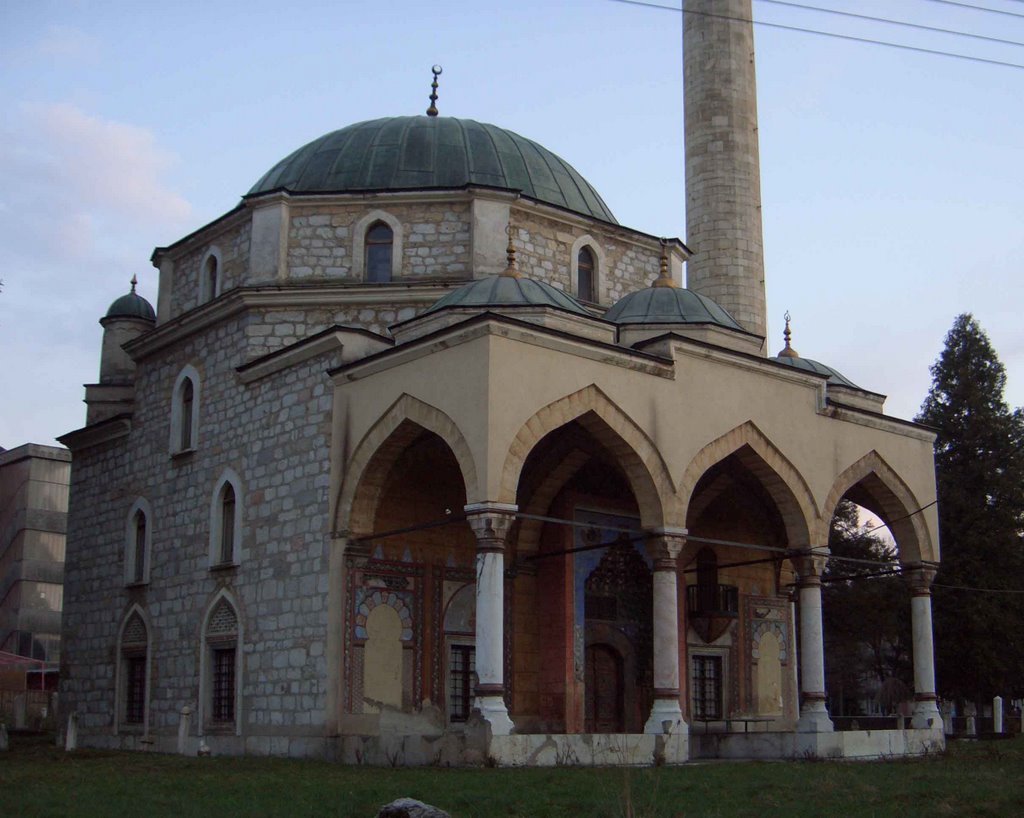
The mosque in Pljevlja. I took these photos in Pljevlja....this mosque was built by a Montenegrin--actually from the Pljevlja area--who became a prominent general/regional governor in the Turkish empire after the Turks gained control over much of Serbia-Montenegro, around 1680, if memory serves me. As a young man, he was sent to Turkey to be educated and then started his rise in prominence.

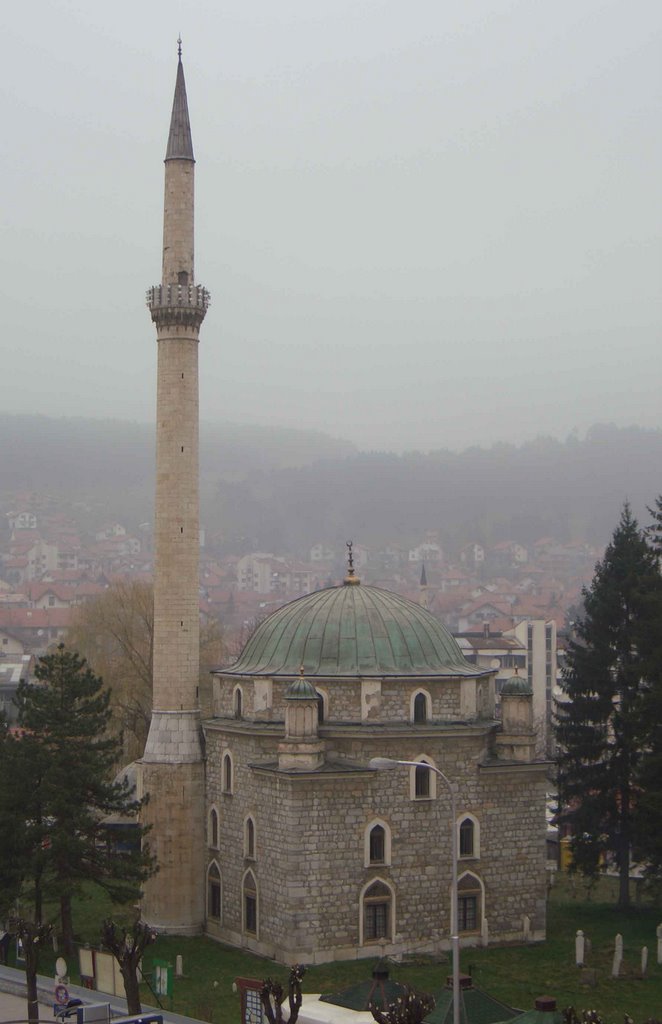
This shot is from the balcony of my hotel room....back of the mosque...but it gives you a full look at the accompanying prayer tower. Locals, so anyway, call this The Rocket. It is a local landmark and always lets you know where you are in the city--provided you can see it.
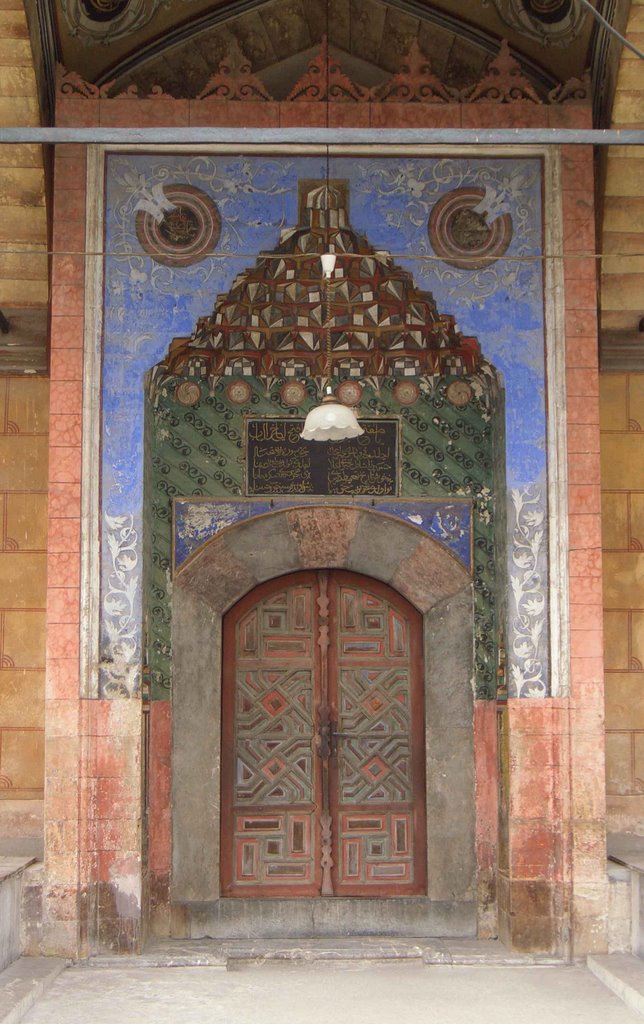
The front doors of the mosque. I probably should have snapped a close-up as well. Simply beautiful. Amazing construction and so impressive that it survived. I asked a new friend if many mosques were destroyed after the Turks left Montenegro....he said generally no and characterized the region as having religious tolerance at the time. And, even today, with 15% of the population Muslim, he described tolerance as being part of this particular area. That was an interesting statement given the killings that took place, motivated by religion and nationalism, in the 1990s. It is all part of the Balkan Paradox.

Thursday, April 6, 2006

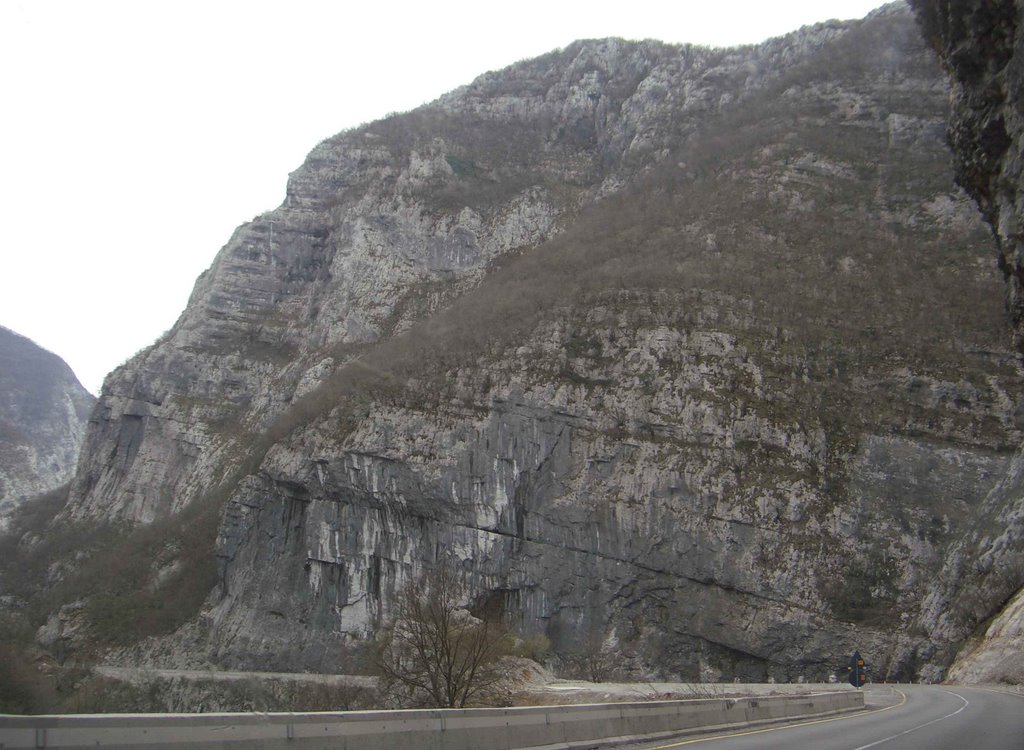
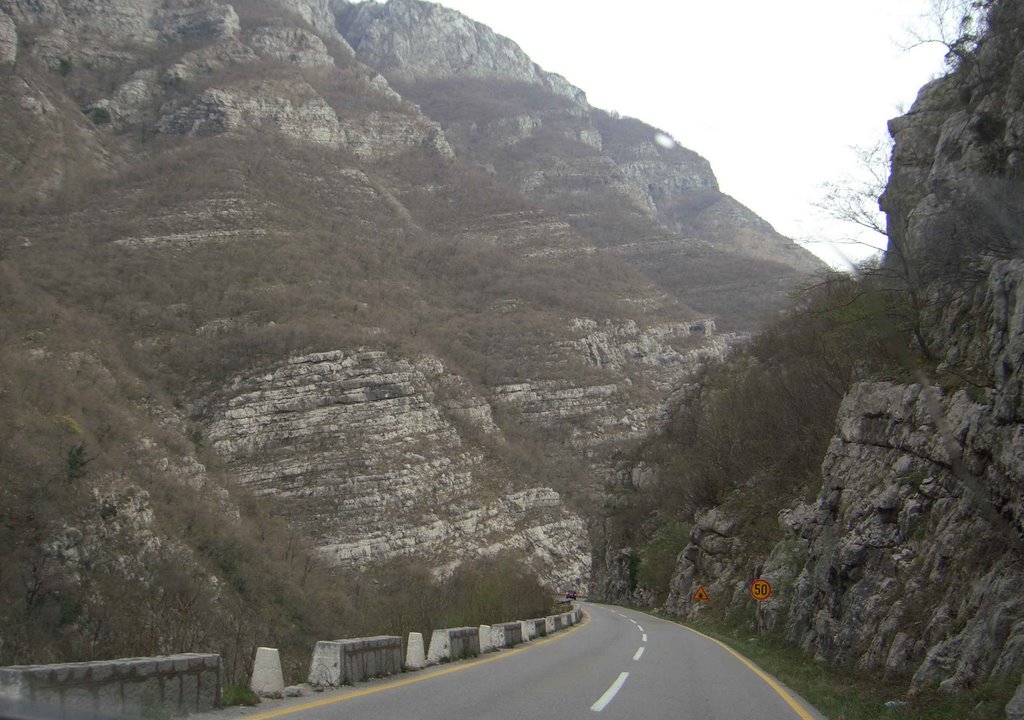
The road from Pljevjla. These photos were taken on the bus ridefrom Pljevjla to Podgorica. I've tried to include some scale reference in the photos....often this may simply mean looking at the road surface to get an idea of the mountain height.


The road literally skirted around the mountains. The trip took about five hours and 180 kilometers....which is about 105 miles. If you could travel in a straight line, the distance would probably be no more than 45-50 miles. If you looked at the pictures I posted from Niksic and compare them with these, you will notice this scenery is less sparse. Near Pljevjla there were substantial trees...easily 3 feet in diameter (timber is an important industry). Some trees are pine but deciduous trees are also common.

As appears to be common, the rocks of the mountains are in layers...stacked on top of each other. But, based on geological upheavals, the layers are not always horizontally stacked. Layers of rock here vary in thickness from two-10 feet. By the way, don't be fooled by the appearance of the road...it isn't all perfectly paved. We traveled through some stretches that had more holes than existing road. I'm happy to say we met a road crew patching the holes. If I get to return to Pljevjla, I will give you a report on the road work.

Titograd? Podgorica resumed it's traditional name in 1990 or 1991. This sign, near Kolasin, has never been changed--and it is one of three I've seen. Why change it? People here know where they're going, right? I did see many newly installed signs directing visitors to places of interest--hotels, food, parks, monostaries.

I am visiting in Pljevlja, in the north of Montenegro—less than 10 miles from the border with Serbia and 20 miles from the border with Bosnia. I’m here at the invitation of Radio and Television Pljevlja, the municipal broadcasting stations of this area of 40,000 people. The city includes an electrical plant, coal mines and timber industry as major employers.

What do you say to someone, about your own age, who tells you he lost 10 of the most productive years of his life when Milosevic was in power? This person doesn’t mean he was imprisoned by the Milosevic regime….he’s simply talking about the frustration of living during that time and having so many options eliminated by war, sanctions, inflation and certainly hatred….all kinds of hardships most people in the U.S. under the age of 50 can’t recognize as being part of their existence. The conversation certainly made some of the problems and concerns of my comfortable life seem very small. And to look at this person’s life now, is impressive.

Some people may say this is why you have to go for the gusto, grab the brass ring, don’t look back, plunge ahead in all that you do in life. That’s one perspective. But another, perhaps, is to cherish what you have and have accomplished. Cherish it today because there might not be a tomorrow. I am struggling, as I sit 5,000 miles from home, to determine the course for me.

I met and interacted with my first hardcore anti-American. The man, it turns out, is a normally mild-mannered traffic engineer for the municipality. But, today he was drunk and happy to tell me, in Serbian, how proud he was of Slobodan Milosevic and that those NATO planes had better stay away from Serbia. My new friend, who lost 10 years of his life to Milosevic, does his best to firmly but politely tell him to go away. I don’t want his rambling to continue either. So I tell my host to tell the guy, “This is the beauty of having a democracy. You and I can speak our minds and know that freedom protects our speech.” I don’t know if this got translated but I hope that perhaps the drunk understood enough English to understand. At the least, it was something to say and I feel better for saying it. And, no, there was no reason to fear for my safety.

How paradoxical that I can meet this fellow after having another person discuss with me the lasting damage to Serbia-Montenegro from the Milosevic regime.

How strange that this should be one of my last encounters in Pljevlja, a city I have thoroughly enjoyed visiting. I’ve spent a day and a half lecturing on media sales and marketing and how to do audience research. With a little luck and planning, I will come back in late May to actually help them conduct a listener/viewer study.

Sunday, April 2, 2006

More photos.... I hope you enjoy them. By the way, feel free to post a comment after any entry you read. It's the one way I have of knowing whether anyone actually looks at my blog.

This was my room at Hotel Splendid in Belgrade. I read about the hotel in a New York Times article about Belgrade as a hip tourist spot. The article described Hotel Spendid as a budget option. It was...but I enjoyed staying there. The room was in the corner so it wasn't rectangular. The furnishing were a little worn but the sheets were clean, there was plenty of hot water, the room was warm, and the people were friendly. My room cost about $40 and I would stay there again.
People sometimes ask me, "What do you bring back from your trips?" Often there's not much to bring back. I don't go to tourist spots and some places really don't have a tourist culture yet. On my last trip home, here are things I brought: local wine and a can of beer, handmade lace, candy--yes, that's a Snicker's bar but it's a Snicker's Crunch, paprika, some Orbit mouth drops and a local competing brand of drops, and best of all....wooden spoons! This was one of the few times I've ever found wooden spoons. They were from Podgorica's green market. The wooden bowl also came from the market. They were sold as practical tools but they were a great find for me. I was sorry to see cheap, wooden spoons that were machine made in China or somewhere in Asia. How much longer will the village spoonmaker be able to continue in business? And, there were plenty of plastic items for sale also.
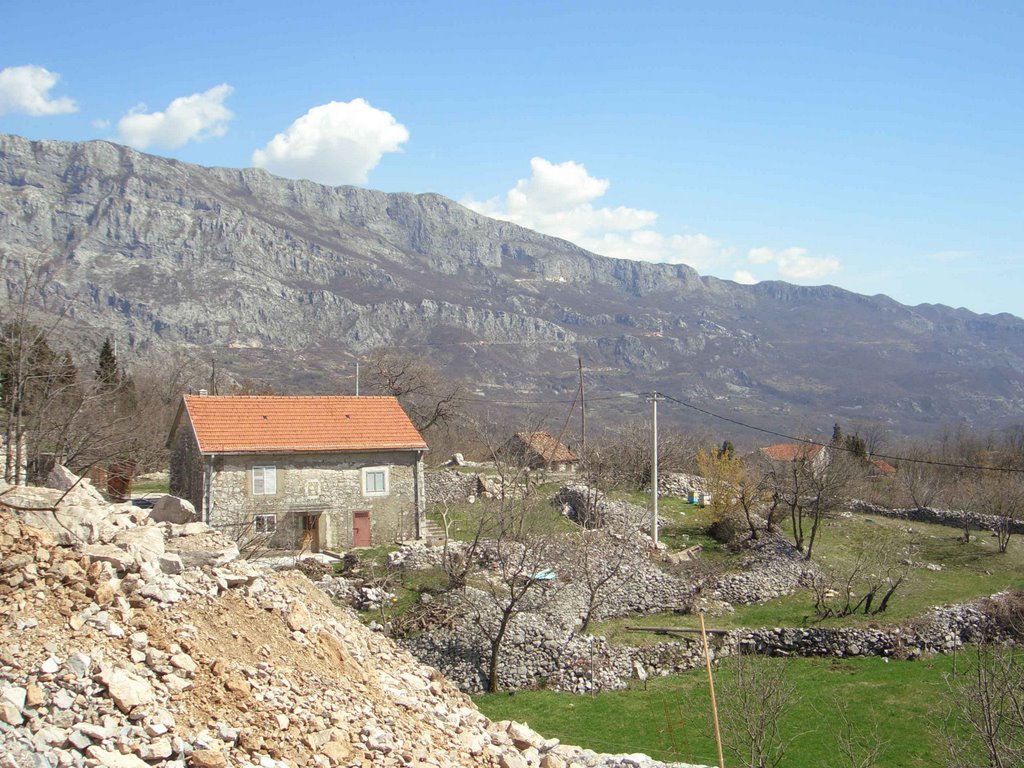
The terrain in Montenegro is fascinating. You see miles and miles of rocky landscape with the occassional oasis of green from a small farm or village. The farm in this photo includes several attractive buildings and the small area of green farm land, surrounded by rocky ground, covered with stunted oak trees. And, that really is one big mountain that overlooks the farm.

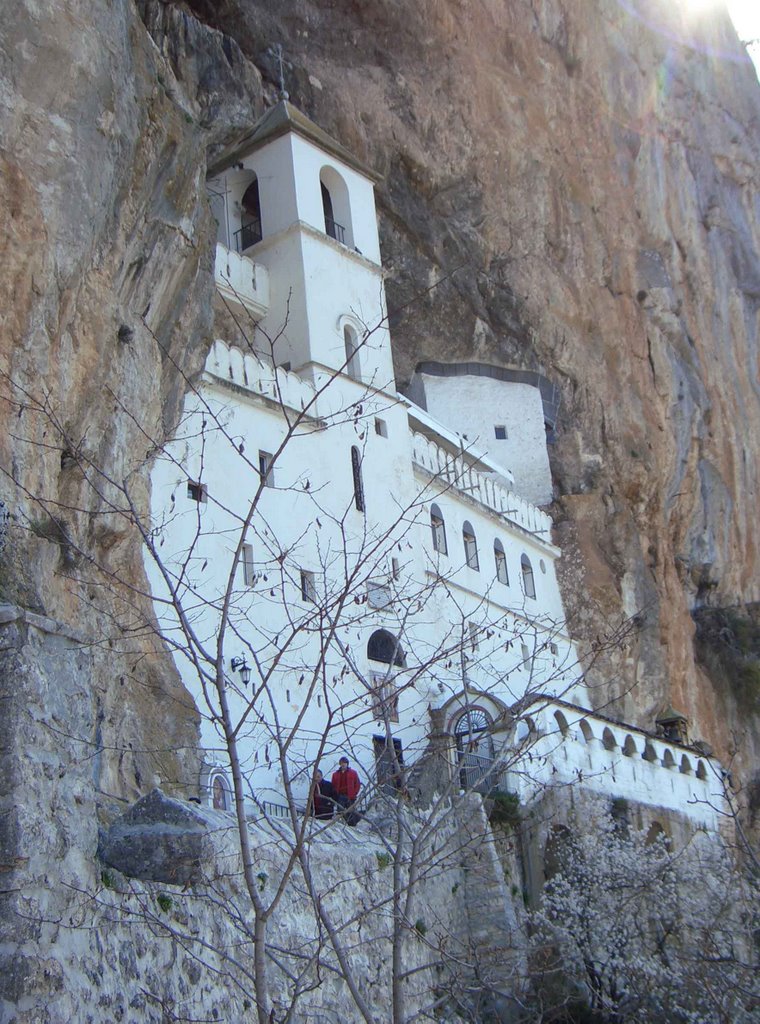
This is the Monestary of Ostrog, located near the city of Niksic. The monastery was built by Saint Vasilije of Zahumlje and Herzegovina, one of the four Montenegrin saints, in 1665. His body, covered by a cloth, is kept in the Monastery and people come to pray to him for health recovery or other matters of faith. I saw the remains and said a quick prayer, myself. Wall paintings in the monostary date from the 17th century. I visited here on a Saturday morning...few people had yet arrived. Inside, near many of the artifacts, were bowls with money....including one near the remains of St. Vasilije with about $700--and a watchful priest nearby. Was it the offering of that morning or from the previous days/week, or do the priests set out a little something each morning as inspiration for the faithful? I dropped in a 5E note.
See the monostary? It's right there....on the side of the mountain. Here's a hint. Behind the house on the foreground, you can see the roof of another building. From the point of the roof, go up a little more than halfway toward the top of the mountain in the photo. That's it. Imagine being a monk and walking down the hill to the valley below to work in the fields....

If you were the monk and walked from Ortrog, you might first stop at this second monostary--a recent addition built in the 18th century--on your way to the valley below. That's it in the photo. The walk from one monostary to another, along a winding road, is about 1.5 miles. From there, you'd walk another 2 miles or so. Going down is easy enough but climbing back up would be real work...especially at the end of the day after working in the fields.

Saturday, April 1, 2006

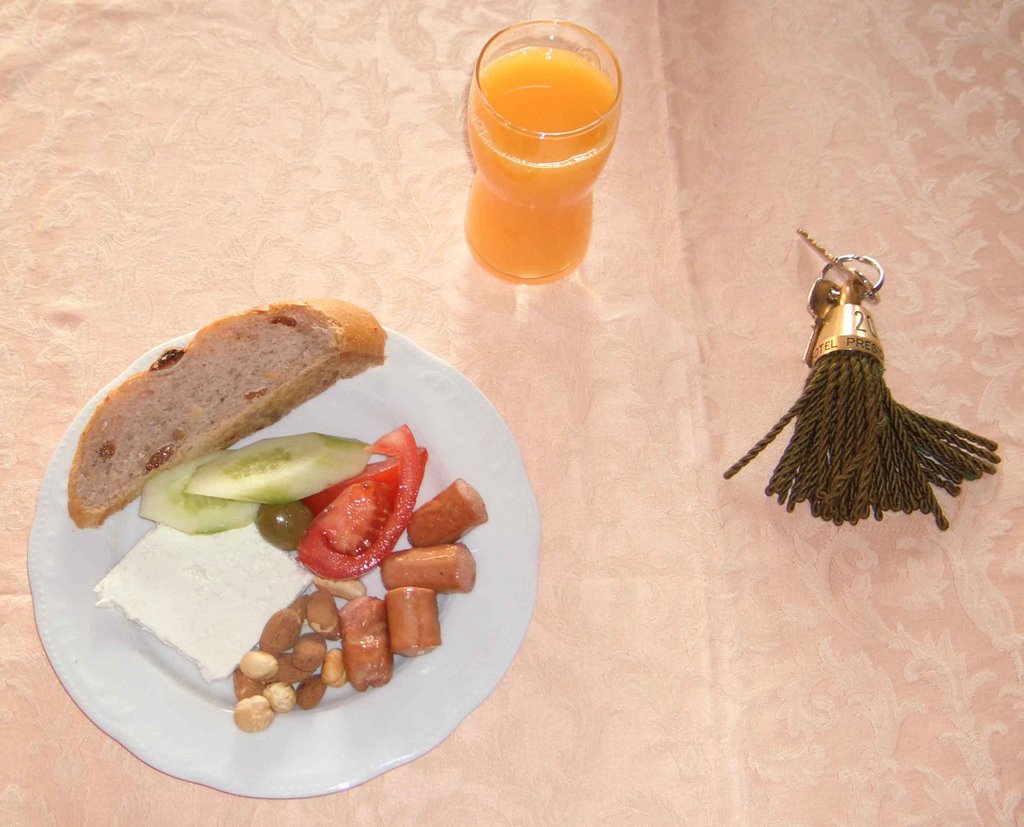
Today's entry consists of a variety of photos...there are minimal connections between the scenes but perhaps my cutlines will be of interest.This is what I call a typical Balkan breakfast. Bread, sliced cucumber, tomato wedges, a slab of white cheese--tastes a little like feta, green olives, almonds and hazelnuts, sausages or ham, juice and coffee. My coffee hadn't been delivered yet. That's the room key from Hotel President. After three previous trips where I stayed in room 102 for some reason they moved me upstairs to room 203 this time.
I live in Peoria, Illinois, world headquarters of Caterpillar, the heavy equipment company. CAT is also well known in parts of Europe for their clothing line with the CAT logo. It's a nice sight to see CAT equipment and it has been a good conversation starter for me on several occasions. A brochure on the desk of a newspaper marketing manager led to a discussion about ad sales. The husband of a university colleague in Ukraine asked about CAT equipment for mining.

This front end loader was working on street construction. You'll notice the head of a fellow who is about to walk from behind the loader. He's not a worker but a pedestrian. As work is done, people continue to take their usual paths. There are few, if any, attempts to block their way. The doctrine of common sense--go if you want but stay out of the way and know it's you're fault if you're hurt--applies.
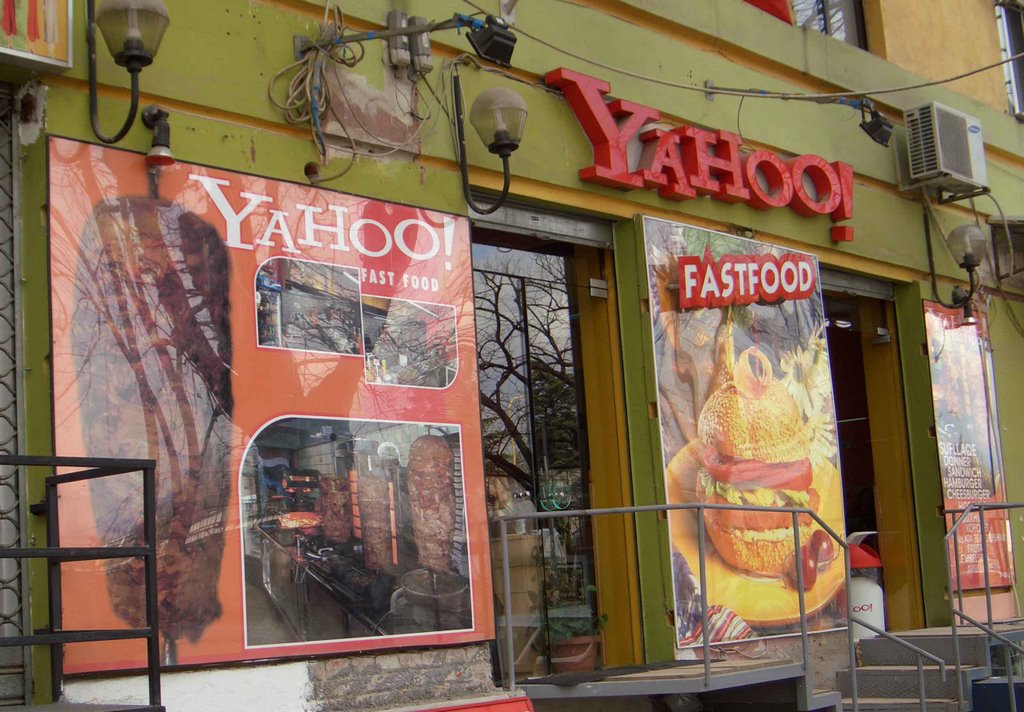
Copyright infringement, anyone? YAHOO Fastfood sells only sandwiches and nothing having to do with Internet searches. Is this a copyright violation? Of course....but hardly worth the time to pursue. It's becoming more common to see borrowed English words in store names. A store in Serbia that sold blue jeans used the same shade of red and font as Levi Strauss but they avoided the Levi's name and called the store Elvis.

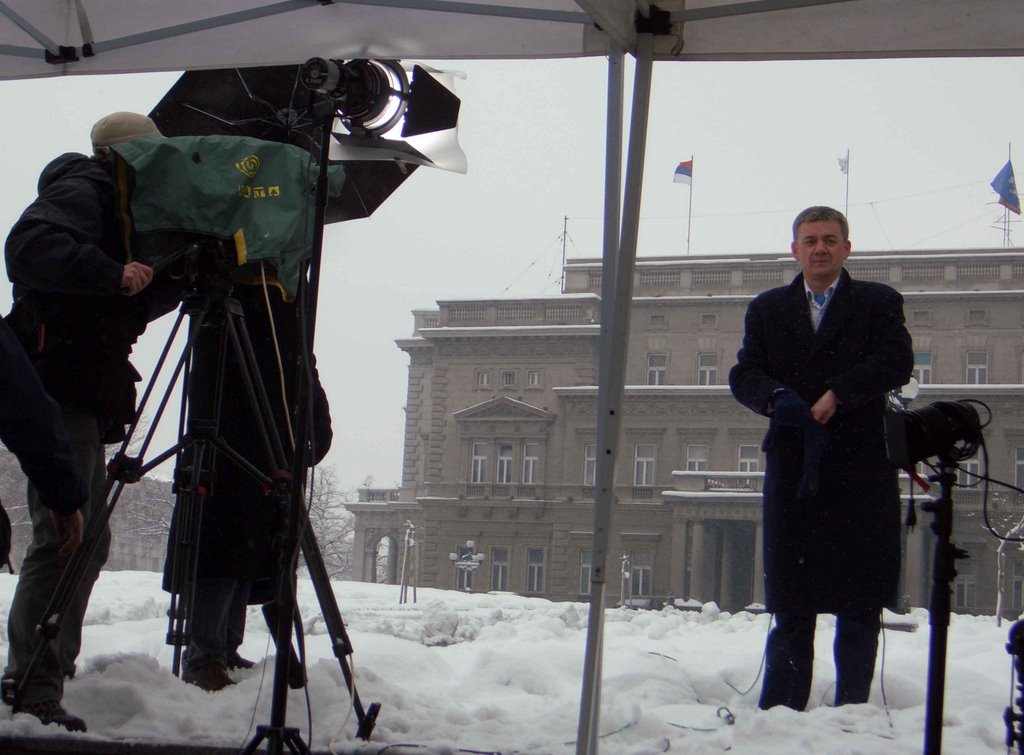
I took this photo on Tuesday, March 14, the day before my flight to the U.S. This guy is a BBC reporter waiting to do a live shot with a morning update on the Serbian government's latest pronouncement regarding burial of Slobodan Milosevic. Besides BBC, a CNN truck was parked up the street, and another unit appeared to be the true "roaming reporter" unit....I saw reporters from four different news agencies/countries do their shots from there. It was snowing lightly and 30-32 degrees on this day. The CNN truck, because of the time difference, was closed up but you could see people inside sleeping or trying to get some rest.


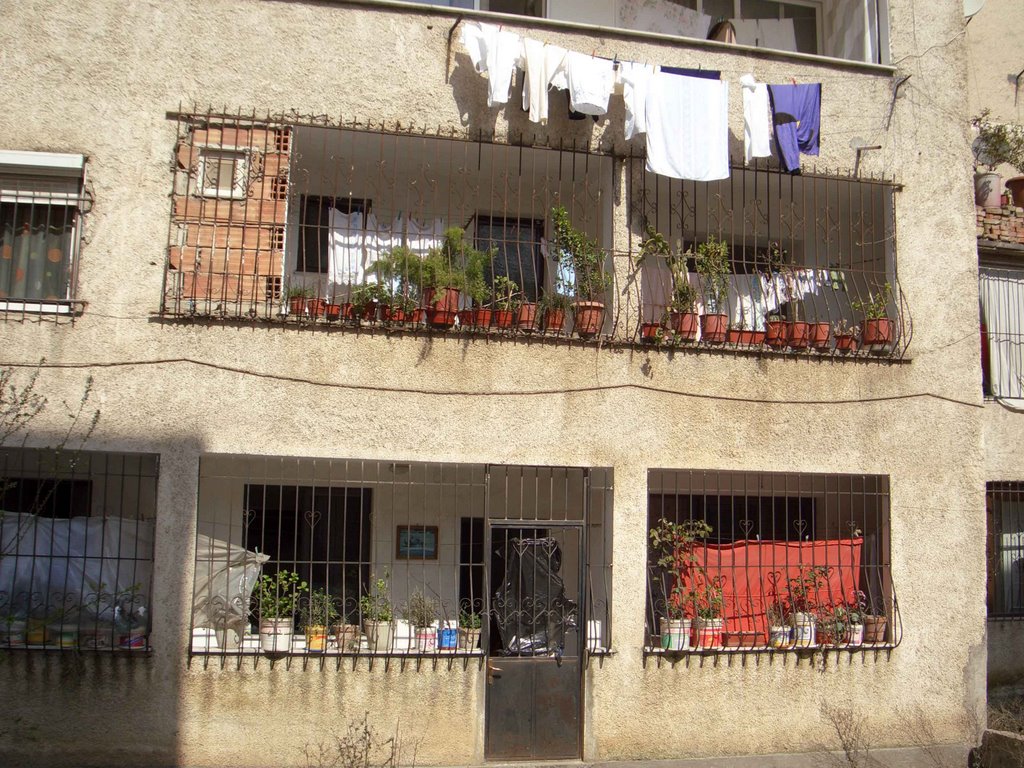
This is an apartment shot from Tirana although the location could be Podgorica or Belgrade--well, Belgrade in another coulple of months. Anyway, look at the plants along the window ledge....lots of effort to add some green to the home and patio....but contrast that with the bars on all of the windows. Life in a green prison? Years ago, in Zambia, I lived in an apartment with an iron bar unit at the front door and bars on all of the windows--even though I was on the second floor. On the advice of a security person, I locked the pad lock on the front door but I never got over the uneasy feeling of wondering how I'd get out if there was a fire.

I've wanted to take this photo for two years.....also in Tirana, just up the street from Vizion Plus and just a couple of doors from my favorite gelato place.... This transmission tower extends into the street nearly four feet and the street isn't that wide. But traffic manages to miss the tower and the approaching vehicles. Interestingly, there is only one wire on the actual tower--and it does not appear to be a major current-carrying line. Most of the wires you see are on a regular utility phone that is on the sidewalk. Also take note of the fruit for sale along the sidewalk....a very common sight.

I wish this photo were larger. I took this photo because it characterizes the chaos of life and the transitions in many Eastern European cities. This is a residential area. You'll see clothing hanging out to dry, the building has some stucco and white painted area but also bare brick showing. An assortment of "junk" is piled out front. Three trash dumpsters sit out front. What you also don't see is a modern apartment building that is just across the street.
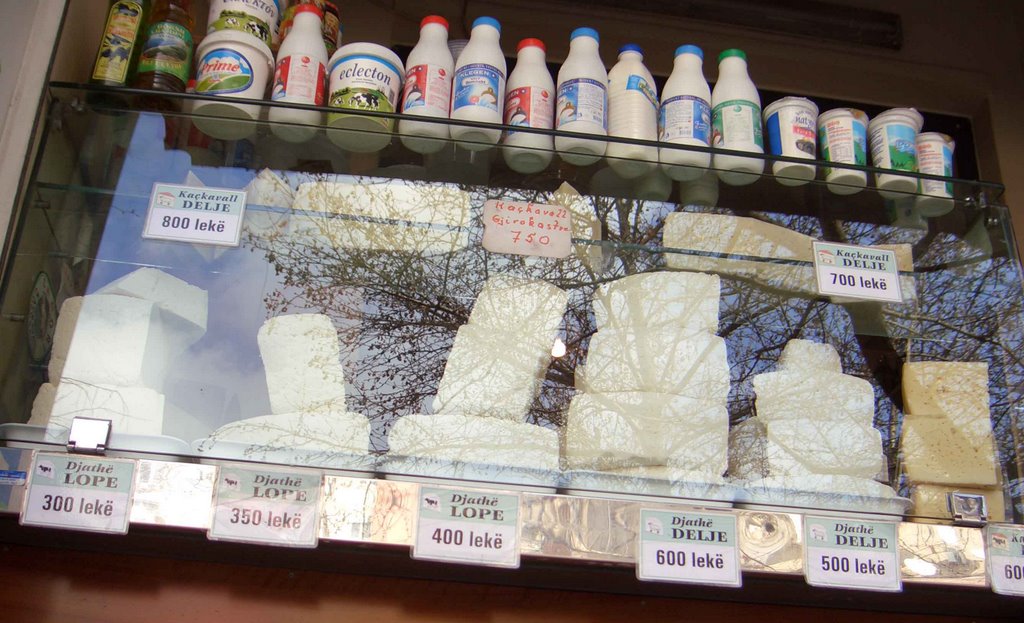
I've talked about the cheeses for sale...here is a photo. Taken in Tirana, the prices are in Leke.....100 Leke equals $1. The prices are per kilogram or 2.2 pounds. People eat a lot of cheese. If the prices seem reasonable you should remember that a pretty good salary is anything above $400 per month. How many kgs of cheese can you afford to buy at the equivalent price of $3 per pound on that salary? The bottles on the top of the case are of various types of yogurt--usually plain yogurt, no fruit or sugar. People buy the yogurt and drink it....I've taken to consuming it also. I think the bacteria cultures help my stomach adjust to local foods.

I took some great photos today in Podgorica. I will try to post them tomorrow.

Thursday, March 30, 2006

I'm backkkkkkk! I am back from Tirana. It is good to be in my apartment again and see the calm lifestyle of Podgorica. The drive to the border, at Skoder, was uneventful. Once we reached Skoder, we encountered more potholes than road as we traveled to Montenegro.

I did what I've heard people talk about doing....I literally carried (well, rolled actually) my suitcases between the two countries. At one point, the border guard in Albania let my host drive into no-man's-land so I didn't have so far to go with my luggage. That was an odd feeling....through one border crossing but with another to go.

Technically, I was entering Serbia and Montenegro. Would I have any problems getting back in? Of course not, I had the visa. (See post for around March 17 or 18 for explanation of the visa controversy.) BUT, suppose I didn't have one? Would it have made a difference in Montenegro? I don't know...and will, unfortunately, not get to find out. The next time I leave, it will again be through Belgrade and I will have to get a multiple entry visa....with luck, I can obtain it in Podgorica.

I will go to the Faculty of Law this evening to listen to two teams of students who are preparing for an Int'l Civil Dispute Resolution Competition. I'm no attorney so the best I can do is coach their presentation--English is the required language--and I will receive copies of their arguments. I will edit their writing, a job I am more than comfortable with. My class meets tomorrow. I gave them a homework assignment before I left....it will be interesting to see who did their work.

What have I done so far, since returning? Why I started a load of clothing in my washer, of course.

Oh...and for readers in the Midwest.... Let me tell you how beautiful it is here today! A high of 20 Celsius, which is about 68, I think? Some flowers are blooming. Leaves are showing on the trees. The sky is blue....it is just wonderful. We passed orchards with peach and plum trees, all blooming.

More soon...including some pictures.

Monday, March 27, 2006

The walk about. I've mentioned before the enjoyment of walking about the cities. There's not much to see in terms of tourist spots but just looking at the shops and people, hearing the sounds, and smelling the smells is joyous.

There are also that elements of good, bad and ugly when you walk around. The bad: trash in abundance sometimes. Dumpsters overflowing, plastic bottles and plastic bags stuck on trees, refuse of all sorts. The ugly: beggers on the street corners....people who beg because they are missing limbs and belong to "marginalized" segments of society. You know there is an even more limited social structure here to help them.

The good: the sharp smells of cheeses--usually white cheeses similar to feta--for sale in small, storefront shops. Bright colors--fruits and veggies of all colors, including some I don't recognize. Plastic tubs heaping with wonderful green olives--buy a scoop for a small sum. The scoop is usually cut from a plastic water bottle. Meat--there's a butcher shop located just down the street from Vizion Plus. I walked past and saw about a dozen lamb carcasses hanging and awaiting final processing. Did I mention the open front to the butchery? It's slightly below ground...the smell is not unpleasant--earthy--and no, there were no flies around. Primitive? Perhaps but certainly not offensive. The smell of people....cigarette smoke, perfume, sweat, laundry detergent...all the smells that are part of being human. Dust in the air--not a favorite part but a realistic part of life. It may have just rained but within a day--maybe two--dust will coat merchandise in roadside stalls. Today, a guy selling bedding was spraying water on the street to hold down the dust in front of his shop. Spices and herbs for sale....many familiar. Some not familiar to my nose but perhaps are familiar to my taste? The rhythmn of conversaton...people laughing, discussing and arguing.

The tone of speech here is hard for me to judge....the flow of words often sound harsh but it is just a different language pattern and people aren't as angry as they sometimes seem to be.

The taxi driver's horn speaks multiple messages but all sound the same: watch out pedestrians, hello fellow driver, don't you pull out in front of me, hey fellow--would you make room for me, speed up/slow down, look out ahead....I've heard all of these as a passenger and while walking the streets.

There are people everywhere selling something. The most basic sellers are the boys dodging traffic in the intersections to sell auto freshening fragrances. And, the old men and women, who supplement their pensions with the sale of roasted sunflower seeds...just a few cents for a shot glass size order. There's also the authentic smell of chestnuts--roasting on a charcoal fire.

I wish most of all that I could convey an adequate picture of the faces I see. They are wonderful. I watched two pensioners (retirees) playing dominos. There was not only laughter on their faces but in their voices and twinkling in their eyes. They smiled at me when they noticed me watching and were probably more amused as they realized by my words that I was a foreigner. Were they curious as to why a foreigner would watch a game of dominos? I was their only spectator in the quite spot where they'd found a cardboard box for their game table and a broken concrete block and a paint bucket for seats. (They were playing the same game my granddaddy taught me to play when I was four or five.)

I do have a camera but I could never take enough pictures to show you all of the intense and interesting faces I see here. Second, I rarely take pictures of people. This isn't a place where people are use to tourists snapping shots. I'm thankful to have a small digital camera for the shots I do take. The faces are rugged....they show the passage of time. I cannot decide if people here look their age or I don't quite look mine. (Although on my last trip home my daughter told me I was turning blond--she was really referring to the silver/gray in my hair.)

Cigarettes and coffee are a part of daily life--especially for men. You see dozens of bars--coffee bars. It is another wonderful place to sit and look as life passes you by.

Are these sights and smells much different than what I might see in the U.S., if I took my time and looked? Probably not but when you're part of another culture, you do take your time.

Saturday, March 25, 2006

The broadcast market in Albania is somewhat better than in Montenegro.

Better is a relative term and has to be explained. First, Albania is a much larger country; Tirana alone has more than a million people versus the 670,000 in all of Albania. Poverty or more importantly, income extremes among the population, are issues in both countries. Both countries have more TV stations that they need but on a per person basis, “station density” is lower in Albania than in Montenegro. Second, program production looks better in Albania. There are some impressive locally produced shows; I would say the programs are better than anything done by local stations in the U.S., but local newscasts are about all U.S. stations do. There is little local program production anymore. Vizion Plus runs a knock-off of “Who Wants to Be a Millionaire?” called “Quiz Plus” that airs on Wednesday and Friday nights. Their kids’ quiz show called, “Tales from the King” features questions about Albania’s history and pop culture and ends with a contestant being named king/queen of the Albanian terrority. Other local shows included a version of “Big Brother” called “Magic Eyes” and an “American Idol” show called “Friday Night Fever.” These are just a few of the locally produced programs on one station.

For a look at Vizion Plus, go to: http://www.vizionplus.tv/

Why do they produce these shows in Albania? Because the audience wants programming that’s produced in their language. International programming is often subtitled, which isn’t as much fun to watch—especially if the translations aren’t very accurate. Many Albanians understand English, Italian and Spanish, thanks to entertainment programming. But local programs are almost always more popular. (One of the exceptions of this rule are the many telenovelas--soap operas from Spain, Mexico or South America--that air in Albania, Montenegro and Serbia. They are subtitled. Because of Italy’s influence in Albania and Montenegro, many people speak or understand Italian and have gradually added Spanish to their language menu.)

Why don’t American stations produce local entertainment programming? Cost and ad revenue are primary reasons. To produce the sort of high production value programming most U.S. viewers demand, would result in programs that would lose money for the stations. You simply can’t price the ads high enough to make enough money to pay the expenses. Most of the Albanian stations have been learning this painful lesson also.

At one time stations jumped into programming ideas without considering how much ad revenue was available to support the program. That fact, combined with an excessive number of stations, has led nearly all stations to be unprofitable. This is generally true in Albania and Montenegro. Another factor of course is the limited advertising market.

(Side note: I’m watching “Inside Africa” on CNN as I work on this entry. What’s that? You’ve never heard of “Inside Africa”? It’s one of many great public affairs shows that Americans never get to see because it only airs on CNN International.)

The star news anchor at Vizion Plus is Sonila Meco. Vizion Plus hired her away from Top Channel, a competitor. It has been a good move for Vizion Plus. In a survey of about 505 respondents, she was the favorite news anchor of 39% of the respondents. The number two person was Ilva Tare, at 20%. She’s the former Vizion Plus anchor, now working for a competitor. I'd like to do a similar research project for a station in Montenegro.

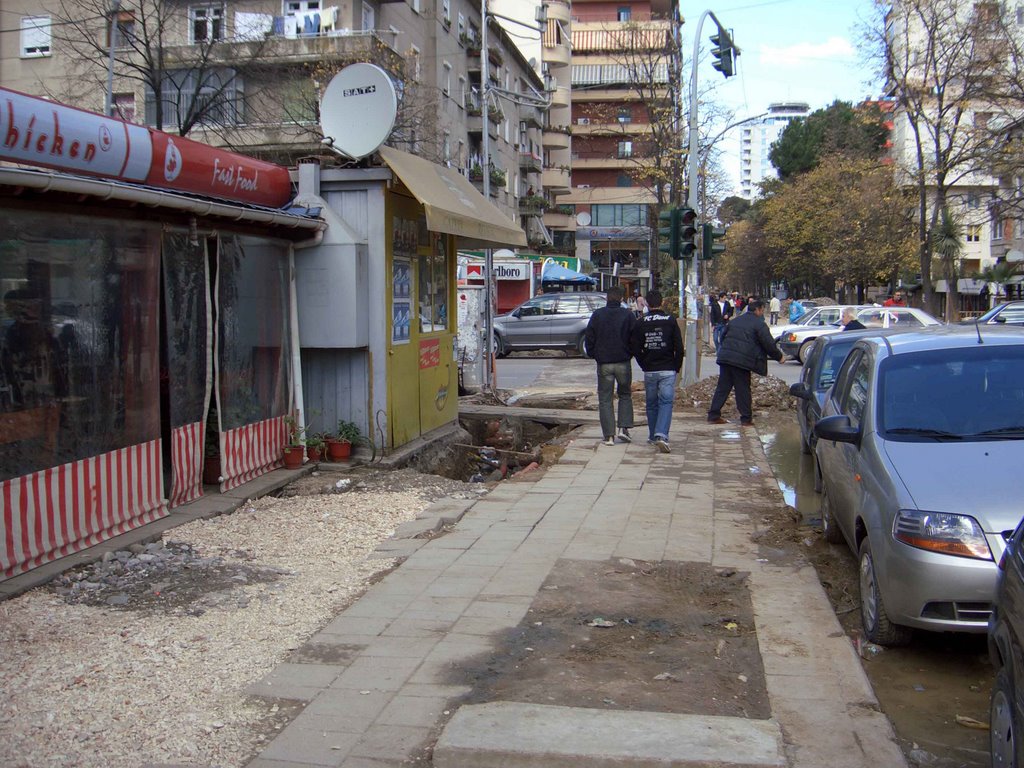
Here’s are a couple of street shots from Tirana. Road expansion has been going on for more than a year throughout the city. It’s not uncommon to have trenches cut across streets or sidewalks, and there are few barriers or barricades to restrict the flow of traffic. One thing I admire about many of the cities I’ve visited in Montenegro, Serbia and Albania is the clear standard of common sense and personal responsibility that’s exists. Keep your eyes open, watch where you’re going and be responsible so that you don’t fall into a hole. And if you do fall, it’s your fault. To the left you see “Mr. Chicken,” my favorite fast food place in Tirana. They sell a sandwich containing chicken, fried potatoes, cucumber slices and plain yogurt, with a pita bread holding everything. It’s a little like a chicken fajita. The sidewalk in front of Mr. Chicken has almost been finished. I'll try to get an after shot... To the left of the young men in the photo is a long trench, about two feet across, two feet deep and 10 feet long. There are a couple of planks that serve as a "bridge" to cross the trench.


\

It’s the little things. I’m in Albania for my fourth time in about two years….It’s nice to be back to a city I know reasonably well and feel comfortable visiting. I’m here conducting audience research for Vizion Plus television, a privately-owned and independent television station that covers most of the country. (Albania shares a common land border with Montenegro….essentially to the southeast. Although I flew here from the U.S., I will return to Montenegro by car.) We’re doing a second audience survey of television viewers to determine what the viewers think about the station’s programming and perhaps generate some information that will help in the station’s ad sales efforts.

I’ve seen not only familiar faces at the station but even on the streets. There’s a spot near my hotel where I normally catch a taxi. The same group of drivers occupies the location. My first day, when I was ready to pay the driver who took me to Vizion Plus, I offered him 500 Leke—about $5—which is about right amount a foreigner should pay for the trip. He seemed to want just a little more so I added another 100. He was very pleased. The next morning, he again took me to the station. I handed him 600 Leke—same fare as the day before—but he would only take 500. And, he thanked me before I could thank him.

I walked back from the station to my hotel last night. I remembered the walk taking about 25-30 minutes. Maybe I walked slower….it took about 40 minutes. Oh, electricity shortages are back. I did slow down a little when the power went out and I only had car headlights to light my way for part of the walk. I had planned to leave with enough daylight to see but conversations ran a little long at the station. I don’t worry about being a crime victim when I walk—even in the dark. I worry about stepping into a drain with no cover or a utility access point with a missing cover. I watched a driver in an old Mercedes back his right rear tire straight into a drain, with missing cover. A group of passersby helped lift/push his car out of the hole.

When I was here in November, Albania had been experiencing electricity shortages for nearly three months. It’s hard for me to know exactly who was to blame for the shortages but essentially, after a presidential election, the outgoing party and new party did not communicate well enough to ensure that contracts were signed to guarantee the import of enough electricity. The current shortages are part of an effort by government to make people pay their power bills. Gradually, the electric utility will suspend service to specific customers. Right now, they cut power everywhere to remind people to pay. The good news is that once side of the street may lose power but the other side will keep it. After an hour or two, the roles reverse.

Speaking of a mess: the streets are a mess from rains, heavy traffic and little road maintenance. Potholes fill many major intersections. There are streets that have been widened and repaved and look as good as city streets in the U.S. It’s an interesting contrast….the past, represented by pothole filled streets….the future represented by newly paved streets and sidewalks.

Mr. Chicken, my favorite fast food place, is still in business. Bird flu apparently has not driven off customers. I haven’t been there yet but probably will go there tonight or maybe Sunday for lunch.

When I walk back to the hotel, it’s a reality check as to the strength of the economy and quality of life. I walk by shops that are still in business after two years. I see some that have closed. I get an up-close and personal look at people on the streets and try to judge their emotional state. Most of the taxi drivers here speak very little English. In other places I’ve been, I find taxi drivers to be full of insights about the economy, politics and life. I miss being able to ask questions of the drivers. The walk helps replace that.

It is Saturday afternoon, shortly past four, as I write this. Most station personnel work six days a week but leave by 3 or 4 on Saturday. I think I will leave also. There’s a gelato place I want to visit on the way back to the hotel.

More later tonight, including some photos.

Wednesday, March 22, 2006

Am traveling again....this time to Albania and then back to Motenenegro. Visit with my family was too short...shortened by a day by the Belgrade challenge.

Had an email from a friend in Montenegro who assures me there is NO need for a visa. So, maybe I am right....just busting my chops. A quick post.....will add more once in Tirana at my favorite hotel...Hotel President.

Thanks to those of you who have kept an eye on the blog. Am on a borrowed computer but will post some interesting comments when I arrive.

Saturday, March 18, 2006

"I was mesmerized by Montenegro" emailed Kellyn G. at the University of Oregon a few days ago before asking how my experience in Montenegro compared with my time in Serbia and Albania.

It's a good question and recent events there--last 12-15 years recent--have offered very different ways for people to react to foreigners generally and Americans in particular.

My contact has generally been good with people in all three countries. My favorite city is Krusevic in Serbia. A wonderful little town...neat and tidy...with friendly people and generally gracious encounters. The timing of my visits has been quite nice--pleasant weather and productive meetings add a nice touch to a visit. Belgrade, like most big cities, can be a bit cold in the encounters. But it's also large enough to walk the streets and blend in...thus giving you a chance to look at the people and events of their daily lives.

I've been on the streets in both cities, speaking English with Serbian colleagues, and have drawn curious looks--some clearly pleasant and others not.

In Montenegro, I've had only good experiences--though I am sure I could find some negative enounters if I put myself in the wrong place at the wrong time. Negative encounters are more likely to be because I'm viewed as a rich foreigner...poverty is an issue in Montenegro. I would say I have generally been well treated in Serbia and Montenegro.

My best personal experiences have probably been in Albania. Because of the NATO/US intervention in Kosovo--where the people are ethnic Albanians--visiting in Albania has drawn the warmest responses from people on the street--taxi drivers, clerks, restaurant workers. That may change as time moves along and discussions about Kosovo's future deepen. Some of the Albanians seem to imagine independence first and an eventual union with Albania. I understand their motives but Kosovo has deep historic prominence for the Serbs.

Television in Belgrade can be pretty sophisticated. My favorite TV station is B92 Television. They are respected for their news coverage. Pink TV is simply slick. Lots of nicely produced local programming, usually involving a variety show, with singers--usually young women--in short dresses. I don't like the programming but the production value--investment in sets, camera works, staging, etc....well done.

Albania TV is pretty good as well....at least among the top three stations. Vizion Plus does the best job with balanced and fair news coverage. Top Channel spends excessively on program production--to the point of losing money on probably everything they do.

Monenegro TV is good, considering the situation. Readers should understand that the TV market in ALL of Montenegro consists of 675,000 persons...this includes the rich and poor. The poor outnumber the rich and there isn't much of a middle class. There are 8 TV stations in Podgorica, a city of about 170,000 and the capital city. That's a LOT of competition for not only viewers but advertising dollars. The 8 stations include two that are national/gov't owned. The other six struggle for viewers and advertisers. There are municipal stations in other cities in Montenegro as well.

Just as in the U.S., people watch TV and assume it can't be that hard to own and run a station. Little do they know... I know of a station that has not broke-even in five plus years on-air.

In all three countries, radio is not that important, except for breaking news or for mobile entertainment. Newspapers are important but some of the papers are so clearly partisan in their coverage as to only attract readers who back a particular party or candidate. There are some television stations that fit in this category as well.

Kellyn also mentioned the weathered faces of people seen when making a trip through the region. This is one of my favorite things to do anywhere I travel....to just look at faces, especially the old. Even someone as young as 50 has lived through some extraordinary events. I have also been surprised at how young looking people think I am...usually they guess I am 10 years younger than I am. Most people in the U.S. would say I look my age.... Again, it's a difference on how we live....(I'll also add that I don't participate in some activities that might make me look older....tanned skin, smoking, or other apsects of hard living--other than my travel adventures.)

Friday, March 17, 2006

Blogger’s Note: I've been traveling since Tuesday, 3 AM Central time. Reached my destination last night, Thursday, 11:15 PM. Here is an entry I prepared Wednesday but did not have access to post. Situation update is at the bottom.

gp

Wednesday, 15 March:

My day could only get worse if I don’t make the 5:20 PM flight to Milan. Even if I do get there, I’m still stuck with an overnight there and a flight home tomorrow. It should have been easy to leave. Maybe if I had flown directly from Montenegro to another country, it would have been fine. But I didn’t….I did the normal, logical thing and came to Belgrade, where I was told that I needed an exit visa. This is absolutely contrary to what I had read and understood on the Serbia/Montenegro embassy site and what my US contacts told me.

I’m officially here for five months but if you stay for 90 days or less, you can come and go….all you need to do is leave and come back. If you do this, you'll never need a visa. And, you can just cross the border into Albania or Croatia…that’s fine. But, because I’m teaching at the university (engaged in scientific research and/or teaching), there’s a requirement that says I should get a temporary non-resident permit. Apparently this permit also requires a visa—even though I was looking to leave after being here only about 42 days. I received this news from a young woman Immigration officer in Belgrade who said, “I don’t think you will be traveling today.” I called the Consulate in Podgorica—actually the mobile number of the PAO. That was at 5:40AM this morning. Within the hour, I had the Duty Officer from the Embassy in Belgrade. By 10:00 AM, they had greased the wheels for me to see Petko Boskovic, THE headman in charge of all visa matters for Serbia.

I had one other bit of luck. I got as a taxi driver a fellow named Boban. His spoken English was fair but his understanding was great. He accompanied me and served as a translator/facilitator as I ran the Serbian gauntlet. My time with Mr. Boskovic was short—literally 2 minutes of conversation. He put a specific person in charge of my visa request….which involved getting permission from Montenegro to grant me the visa in Serbia. (Montenegro and Serbia are like two siblings, Serbia the older one. They sort of get along—well, they are supposed to—but they snipe at each other). Bottom line, by 1:20 PM, I had my visa. Now the challenge is to get a flight. I should also add that I paid an arm and leg to Boban—5,500 dinars, which is 55Euros or about $65. It was money well spent. We also spent nearly two hours just talking about life and circumstances. Very insightful. When he quoted me the price—based on something he said later when I asked for a receipt—he was under the impression that I would just expense the cost. That is of course what real business people often do. (He was really impressed that I could get an audience with THE head of the visa office and apparently was mistaken into thinking I really was somebody.) I explained, when I got the receipt, that the best I could do was deduct it from my taxes next year. I don’t know whether he worked any more today or not but he often won’t make that much money in a full 10 hours of work.

I did manage to make a call to Stephanie, where we both almost cried. Worst of all, she leaves Friday morning for a wedding. I am happy she is going. She needs the time and it will be a good weekend for me to bond with the children.

My Alitalia guy is working on my ticket to Milan right now. I am hoping that somewhere I will get a break on something. Maybe I have used my breaks up by getting the visa taken care of. I just want out of Belgrade. Maybe I have caught another break….a fellow just stopped by with a present of chocolates for the Alitalia man. The guy said he was allowed to board at the last minute for a flight to Milan, about a month ago, and my guy was the fellow nice enough to let him do that.

Remember that Tom Hanks movie about the guy who gets trapped in an airport because his Eastern European country declares independence or something? He no longer has a way to enter the U.S. and because he can’t enter, he can’t leave. My situation is not that bad—I don’t think.

I keep asking myself, did I do something wrong? I reviewed the email this morning that told me about the temporary stay non-resident permit. It said nothing about needing a visa. I don’t think I did. Should the low-level bureaucrat in Podgorica, who issued the temporary stay non-resident permit have know about the visa? Maybe she should have but I have no animosity in my heart for her. There’s a strong fatalism that people in this part of the world have. It’s almost as though they look forward to things going wrong. A common phrase I have heard people utter, “This is our reality.”

Why would you ever choose to live life this way? I can’t imagine but I know that in my naïve life, I did not live through the bombings the city took in the 1990s from NATO—deserved bombing because of their attacks in Muslim communities in Bosnia and most recently in Kosovo. I also did not live with the economic sanctions and hyperinflation that the Serbs encountered, where a wheelbarrow full of money would not buy a loaf of bread if you were paid in the morning and waited until the end of the day to buy the bread. And, I can only remember things I’ve read in history about World War II and the invasions by Germans and Italians and later the allies, including some U.S. troops, and of course the local partisans who were shifting to socialism for the country as they fought against the Germans. And, let’s not forget about 400 years of subjugation under the Turks. (The whole Kosovo issue is because Kosovo is the site where the Serb king was defeated by the Turks to begin their 400 years of rule. Rubbing salt in the Serbian wound, Kosovo is populated mostly by ethnic Albanians—who are Muslim—thanks to the Turks.

But all of these things I think would make me want to embrace some new point of view. Why live a life expecting the worst when sometimes just the act of living will mean you naturally receive the worst. Why not try for a better outlook in the hope that maybe things will work out just fine.

If I saw a glass sitting on a table with water filled to the halfway point in the container, I would absolutely declare the glass to be half-full. A Serb and some Americans would say it is half-empty. Life is challenging enough without making it any more difficult by expecting, indeed hoping, for the worse possible outcome. That is my reality.
-0-

Update: Prepared Friday, 17 March, 12 Noon, Central

I made the flight to Milan…had the last seat…got in by about 7:30PM. Spent the night in the Milan airport because there were no nearby hotel rooms available. The ride into Milan by bus was at least an hour…I needed to be back to talk with Delta at 7:30 AM...did not seem worth trying to find a room there. Slept pretty well, considering. Got a flight to Chicago and connection on American to Peoria that would put me home by 5:30 PM—four hours earlier than a Delta flight from Atlanta. Arrived in Chicago as snow started. Flight to Peoria was canceled. Took charter bus home…arrived by about 11 PM. Got up at 4:50 AM to see my wife off. Weather is now fine. Made pancakes for my children and took then to school. The glass is half full.


Monday, March 13, 2006


The Green Market: When I’m home, I love
going to the grocery store. I like looking at the merchandise on the shelves—colors and smells, the packaging, product displays, merchandising approaches. Similarly, I enjoy going to the grocery store when I travel for the very same reasons. It’s also a good reality check on the quality of life for local people. What can they choose from in the grocery? How much do things cost? What U.S. products or European brands also sold in the
U.S. are sold here? When I see nice
packaging, I immediately see where the item was made. Sometimes I find something made at a local factory but perhaps there’s a logo for P&G, Unilever or Kraft discretely on the packaging. It is encouraging when I don’t find this because the product may be a true example of a local success story.

Many stores in transitional countries are very small—perhaps no more than 10 by 16 feet in size. Montenegrins stop at the market nearly every day to buy food for the evening meal and breakfast the next day. As automobile ownership increases, it is changing the way people shop. Automobiles, along with bigger refrigerators, allow people to buy in bulk,
once a week and store their purchases.

Saturday I had a real treat; I went to the local “green” market—similar to a farmer’s market. I love these. Produce is very fresh. It’s wonderfully arranged. There are vivid colors and intense smells. This market included live trout for purchase, truly fresh fish. I saw tubs of green and black olives, churns of soft white cheese in wooden churns, wheels of pungent hard cheese, specked on the outside with mold, and of course smoked meats. Besides produce, there were gardening tools, clothing and household
items—mostly stuff imported from China, and a few
locally made handicrafts, wooden spoons and some knitted items.

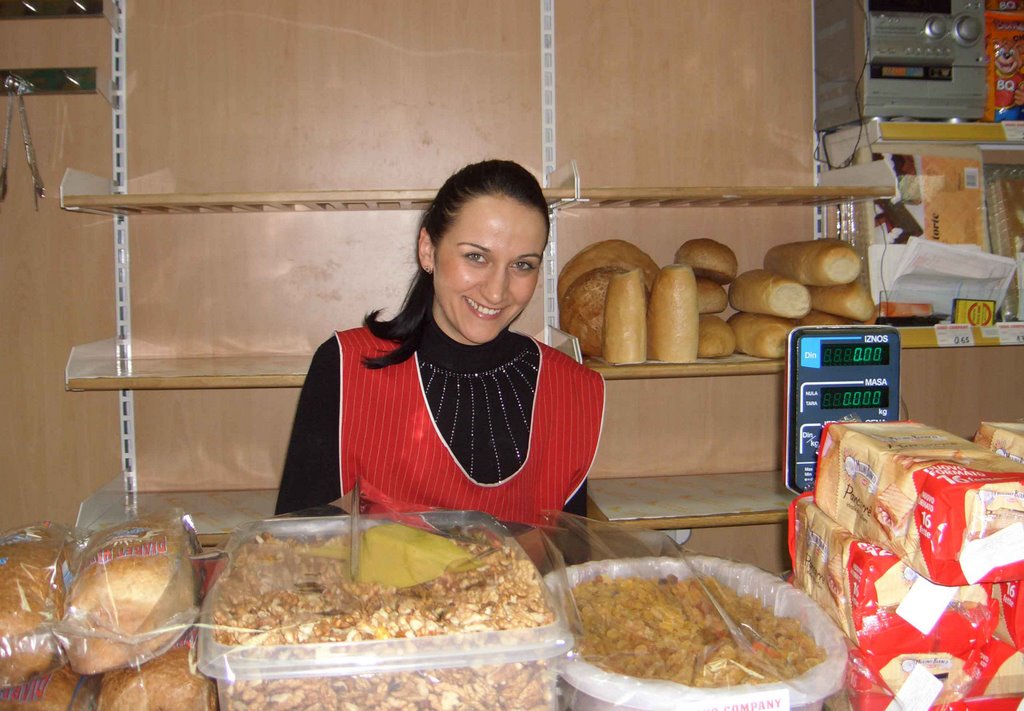
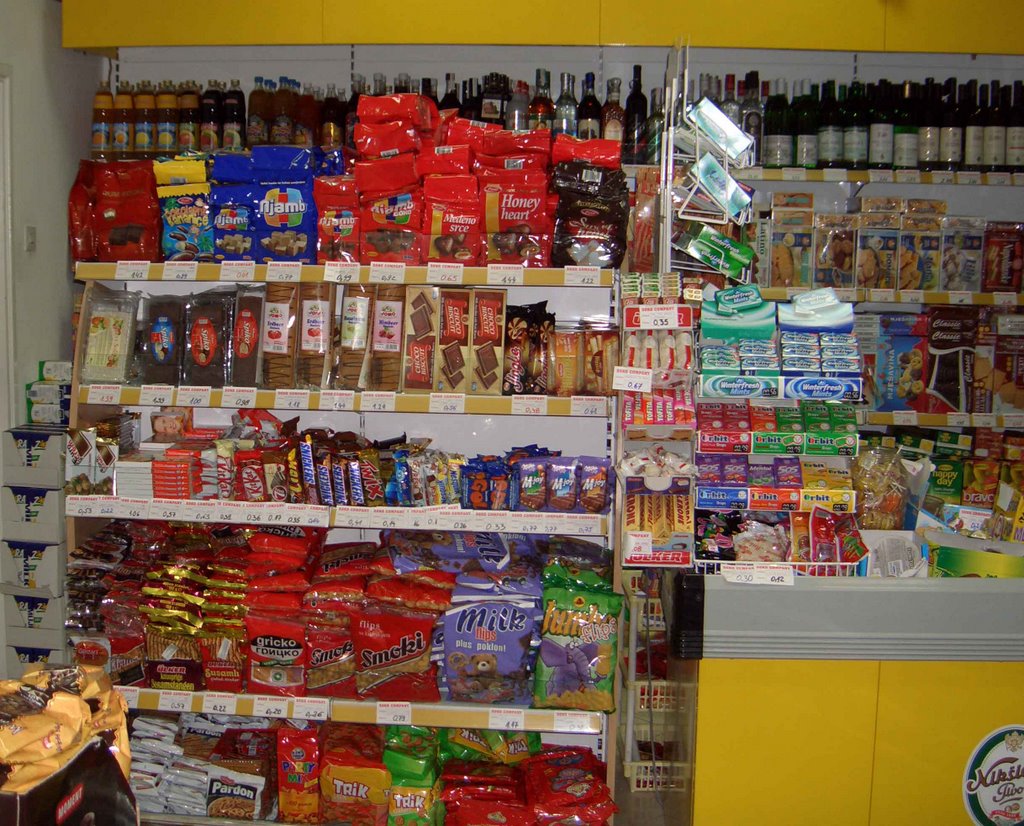
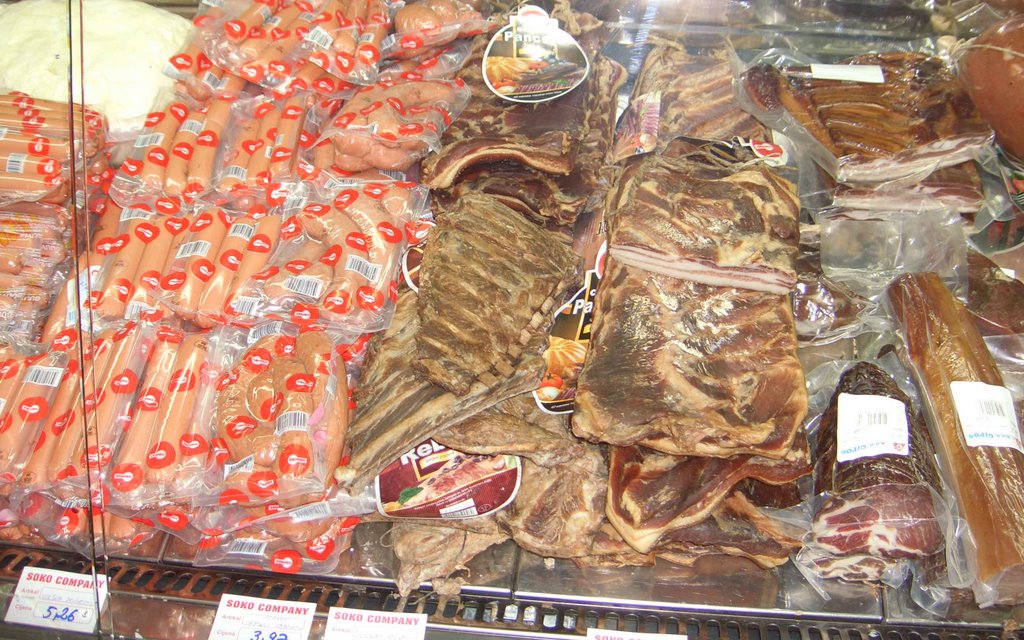
I’ll take some pictures on a future trip. This time, I just wanted to soak in the experience. I have included some pictures from a local market near my apartment. The young lady works the evening shift. She doesn’t speak English but she always has a smile. Notice the shelves behind her. They were filled with fresh bread this morning. Now, a few loaves sit, waiting for a customer. When you buy a loaf, the attendant picks up the loaf with an inverted plastic bag so that human hands don’t touch the loaf, that has been sitting in the open. Bread is very good. Nice texture and taste. In the meat cases, you’ll see some smoked sausages and other smoked meats. The plastic sleeves hold cold cuts—one is basically chopped ham for sandwiches (it’s pretty good). The price labels are usually the price for one kg, which is 2.2 pounds.

In the shot of the jams and jellies, you’ll notice Barilla pasta sauce just below. Beyond the paste sauce, on the same shelf, are jars of picked peppers and vegetables. Oh, and don’t forget to look at the packages of instant soups. I start with potatoes, onions and carrots but add a pack of instant soup to shortcut my preparations.

Next to the register are the snack foods, impulse purchases with high margins. The back shelf contains the selection of spirits. Fresh produce sits outside, next to the Coke cooler. The produce selection is limited—apples, kiwi, oranges, lemons, cabbage, onions, potatoes, carrots and sometimes cauliflower. I’ve probably left out something but you get the idea.

Saturday, March 11, 2006

Tonight, I gambled and lost. When I travel to a country where the “local language” (that’s how many Montenegrins identify Serbian…the language they speak…they don’t acknowledge their connection with Serbia…but I digress)….. When the menu isn’t in English, I practice “blind dining” which means, I order something and expect the best when my surprise meal is delivered. (Once in Munich, a friend was served pickled fish in sour cream; I got pork roast with crackling skin, and roasted apples.) Until tonight, after doing this for 10 years, I had a perfect record of meal satisfaction. Sometimes the food was unusual but it was always good. Tonight, in Café Piccadilly, my dinner plate-sized Piccadilly Pizza (recommended enthusiastically by my waiter) contained anchovies. And not just one or two but seven. I like sardines and could have handled one or two anchovies but seven was a little more than I wanted. Even after I scrapped away most of the fish, some grains of the coarse salt they had been packed in added a distinctive crunch to my pizza.

The good news is that I need to drop a few kilos so leaving some of the pizza on my plate wasn’t a bad thing. I also had a Greek salad that contained some of the best green olives I’ve ever eaten. I ate more than a dozen olives and still left nearly that many. There were black olives also but they’re not as tasty.

A friend emailed to ask about food preparation and hygiene standards. As a transitional country, I would say that food sanitation practices in Montenegro appear very good. More expensive restaurants probably have better sanitation practices—though not always. Usually I order a shopska salad, it’s made with diced tomatoes, cucumbers and onions. Sometimes a little parsley is added, as well. The salad is dressed with a little vinegar and olive oil and topped with shredded white cheese. It’s very good and I really want vegetables when I travel. The carbs from pizza or fat from heavy meat dishes are too much for me. I also figure the shopska is better than ordering a green salad, with lettuce washed in tap water. Tonight’s Greek salad contained lettuce but also had a tart vinegar dressing.

A few days ago in my entry covering Quirky Observations, I mentioned not buying any smoked meats. Many of the grocery stores have racks full of smoked meats behind the counter. It just hangs, preserved by smoke and salt, until sold. I’m sure the microbes are part of the local digestive systems and present no problems. And, when I’ve eaten the smoked ham at breakfast at a hotel, I was probably eating meat similar to what I saw hanging.

I saw an American, whom I recently met, drink a glass of tap water after finishing his espresso. When I want water, I order sparking water—water with carbonation. It’s an easy way to know that I’m not drinking tap water. In 2000, while on a trip to Bulgaria, I got sick from something. Maybe from water? Probably, a marinated, roasted pepper salad. It was delicious at the time. If someone else is paying my travel tab so that I can conduct a workshop, I can’t afford to call in sick.

Being adventurous is one thing. Being dumb is another. By the way, if you’re in a part of the world where you have concerns about water or hygiene practices, DO NOT rinse your toothbrush under the tap in your hotel room. A couple of years ago I was chatting with a guy on a flight from Kenya to Minneapolis (I was coming back from Uganda but had connected in Nairobi). He told me the trip had been miserable….stomach troubles…he said he watched what he ate and drank only bottled water. I asked him if he’s rinsed his toothbrush under the tap and he almost got sick again.

Find a kiosk or "mini mart" (small shops that sell cigarettes, newspapers and bottled water) and stock up so you're not at the mercy of your hotel, where a bottle of water costs $2-3 for 300 ml, about 11 ounces. Usually for the equivalent of .50-.70 cents U.S., you can buy a 1.5 or 2 liter bottle of water at one of the shops next to your hotel.

One more thing, it was another rainy day in Podgorica. My boots kept my feet dry and I didn't get splashed by a passing car.