

Forbes.com http://www.forbes.com/business/energy/feeds/ap/2006/09/28/ap3053440.html
Associated Press
Hughes: Fixing U.S. Image May Take Years
09.28.2006, 05:42 PM
|
|
|
|
It may take decades to change anti-American feelings around the world that have been aggravated by war in Iraq, U.S. policy toward Israel and America's "sex and violence" culture, the State Department official in charge of dealing with the U.S. image abroad said Thursday.
"The anti-Americanism, the concern around the world ... this ideological struggle, it's not going to change" quickly, Undersecretary of State Karen Hughes said in an interview with The Associated Press. "It's going to be the work of years and maybe decades."
Hughes, a longtime adviser to President Bush, has worked for more than a year to retool the way America sells itself overseas, but she acknowledged that success can be next to impossible to measure.
A June poll by the Pew Research Center for the People & the Press found that America's image in 15 nations dropped sharply in 2006. For example, less than one-third of the people in Egypt, Pakistan, Jordan and Turkey had a favorable view of the U.S.
According to that poll, America's continued involvement in Iraq was seen as a worse problem than Iran and its nuclear ambitions.
In the bleak National Intelligence Estimate portion declassified this week, the government's top analysts concluded that Iraq has become a "cause celebre" for jihadists, who are growing in number and geographic reach. If the trend continues, the analysts found, the risks to the U.S. interests at home and abroad will grow.
Hughes said the three-year-old Iraq war "is the most recent excuse" for anti-American grievance in the Muslim world.
"Much of the world did not agree with our decision to go into Iraq," just as there is long-standing disagreement with U.S. support for Israel, Hughes said.
Answering those complaints and defending U.S. policy is part of Hughes' job heading the broad category of U.S. outreach known as "public diplomacy." Although her job involves all regions of the world, Bush asked her to concentrate on reframing the U.S. image in the Islamic world.
"All you have to do is sit in a hotel room in the Middle East and watch the media and you see there is a lot, there is a big drumbeat out there going against our interests," Hughes said.
"I'm trying to approach this as putting in place the type of things that over the long run will make a difference for our country, because I don't expect that in the two years and ... three or four months of the president's administration that we'll see a significant shift."
Hughes has sent Arabic speakers to do four times as many interviews with Arabic media as in previous years and set up three rapid public relations response centers overseas to monitor and respond to the news.
Asked whether America's critics have any legitimate gripes, Hughes said yes.
"One of the things that I hear a lot, particularly in deeply conservative societies, is that parents feel kind of assaulted by American culture," Hughes said. "The sex and the violence that they see on television and movies ... some of the lyrics of our music."
The fact that American culture is so pervasive and accessible around the globe is "a double-edged sword," Hughes said. "Obviously, a lot of young people find our pop culture very appealing."
Hughes said the United States must be careful not to cast its fight against extremism and terrorism as a confrontation with Islam as a whole. She would not say whether she and Secretary of State Condoleezza Rice had advised Bush to stop using the term "Islamic fascism" to describe the ideology behind terrorism.
Bush and his spokesman used the phrase several times in August, but it has apparently disappeared from the White House lexicon since then. A check of transcripts on the State Department Web site indicates Rice, who is Hughes' boss, has apparently not used that phrase.
Hughes said that while she would not reveal private conversations with Bush, "that has been a subject of great debate within the administration."
"It's difficult to know what to call the ideology that we're up against, because it is a perversion of Islam," Hughes said.
"I use 'violent extremist,' because I think they are extremists, they are violent, they are actually mass murderers who pervert their religion."
Copyright 2006 Associated Press. All rights reserved. This material may not be published broadcast, rewritten, or redistributed
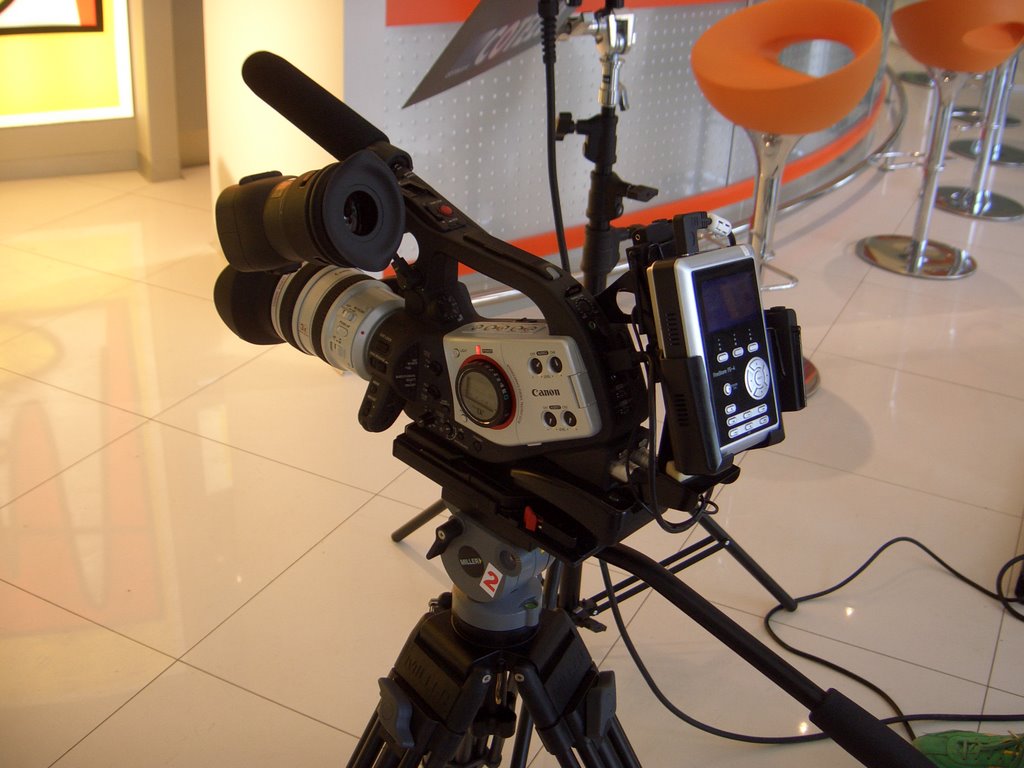
 Here's their neat little Canon camera with a firewire attached harddrive. The audio connection is wireless...though you also see an attached camera shotgun mic. They were shotting a wraparound for a show while I was there. Then they unplugged the harddrive and connected it to a computer for editing. Editing is done with Adobe Premiere. It's a known software in the region...easy enough to find people who are experienced users...and it will do what they need to do. And did I mention, it's cheap to buy, install and maintain?
 Here's a slightly tighter shot of master control with people blocking the view.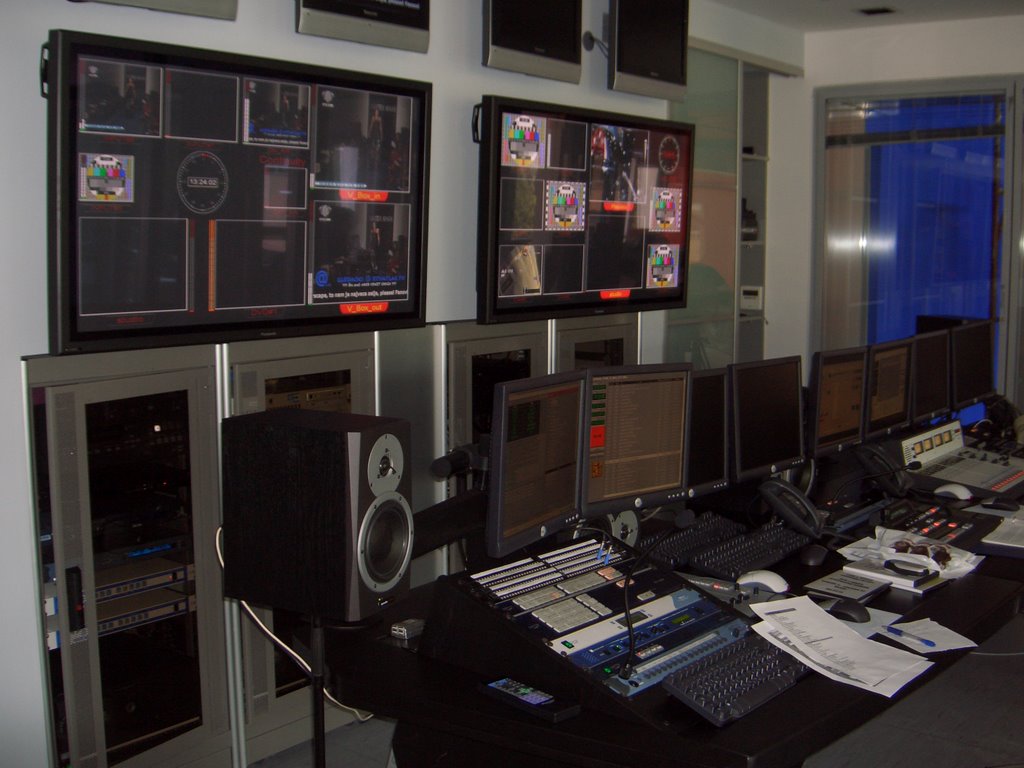
Johnnie Walker: It was like a scene from a John LaCarre or Tom Clancy novel. When I arrived at the border crossing from Montenegro to Albania, the Montenegro side seemed to be just starting their day…everyone wasn’t quite awake, though it was 8 AM. I was ordered back outside the border control building by a fellow holding a bottle of Johnnie Walker Red…an open, half-empty bottle of Johnnie Walker Red. He stepped across the room and out of sight. When he returned, he had a glass in one hand and the bottle in the other hand. Now, I can’t say for certain that he poured a glass of JWR for breakfast but that’s what it looked like to me. I promise; I’m not making it up. The officer who appeared moments later and took my passport was a nice looking, young and clean-cut guy. He was polite, professional and wished me a good day. I’m in Albania today. I’m here collecting some job satisfaction data for a research project.
-0-
-0-
-0-

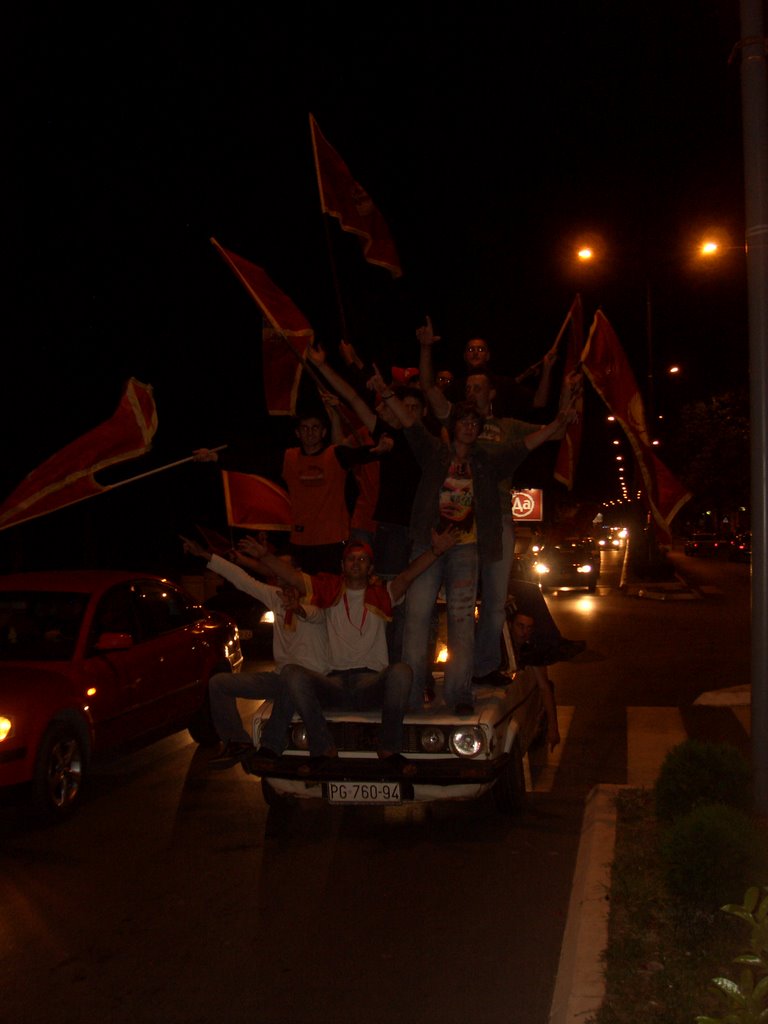
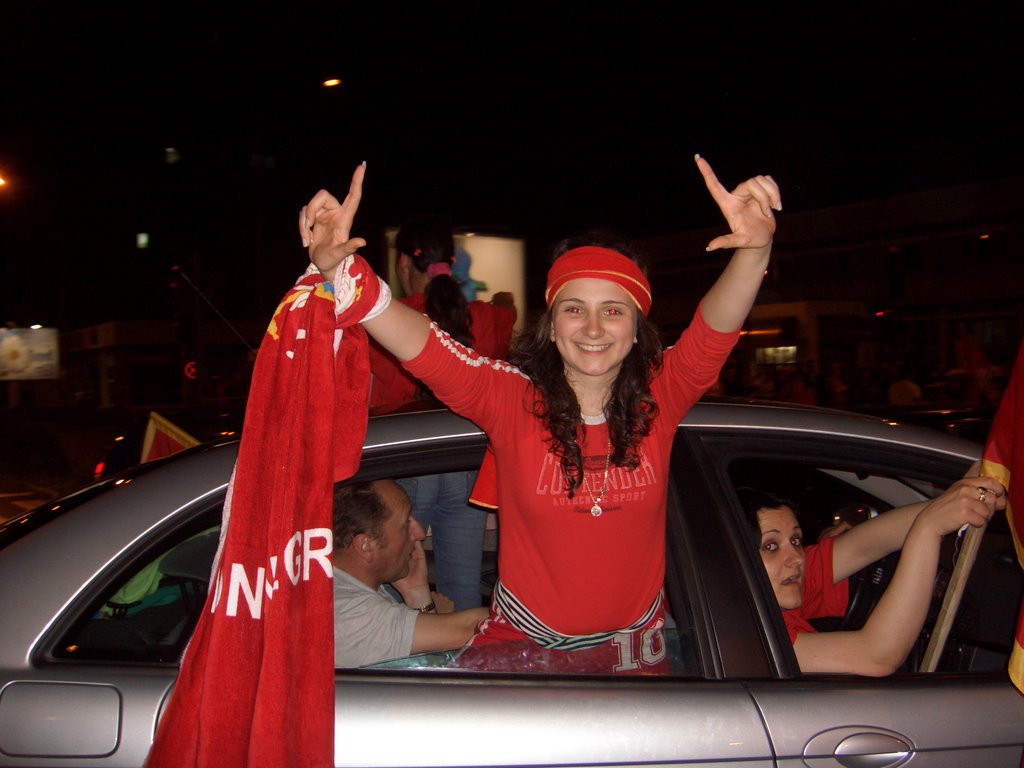
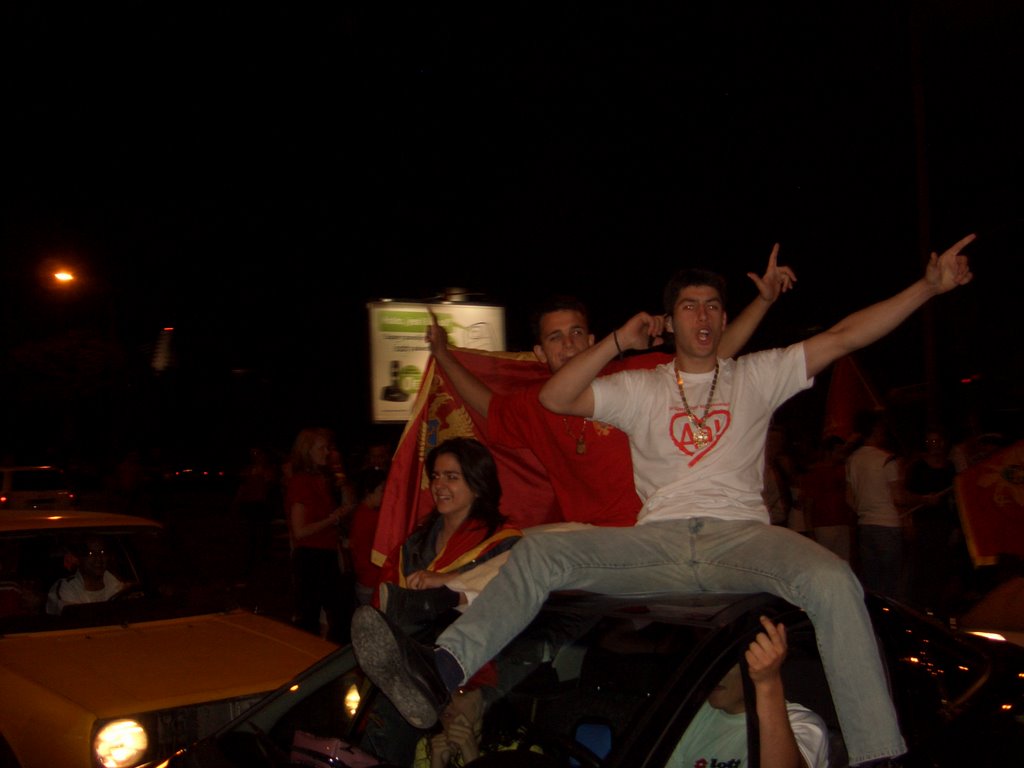
The Little Engine That Could: It isn’t often that you have a chance to watch a country gain independence—from ground level. I have just done that. Montenegro is on the brink of becoming an independent republic. Unofficially, I’m told the approval vote for the independence referendum was 56 or 57%, with approximately an 86% turnout; the referendum needed 55% approval for recognition by the EU. (Too bad Americans can’t achieve an 86% turnout for our presidential elections. I suppose when you live in a democracy, that also means taking your freedom for granted.)
The last time Montenegro was mostly free was nearly 100 years ago but wars in the Balkans ended their monarchy and led to their absorption by Serbia. I watched the initial returns with some local friends and then walked back to my apartment. As I returned, cars were pouring onto the streets, each car packed to capacity with youthful enthusiasts, waving the flag and yelling, “Viva Montenegro” as they raced down the highway.
Opposition leaders are not yet willing to recognize the results. There is word that the opposition parties are calling on their followers to go onto the streets and not yield to the independence movement—not until the official vote numbers come out tomorrow. If this happens, I think there could be some scuffles. I don’t know that they’ll be bad…maybe some rock throwing and fist fights. I hope this is all. I suspect there’s a greater risk of a fatality from an auto accident or pedestrian being hit by a passing car. There’s been some gunfire…just shots into the air to celebrate, including two bursts from an automatic weapon—with tracers. The police are on the streets so order should be maintained.
The celebrants on the streets are mostly young people—perhaps 16-30 years old. I wonder if they know just what they’ve gotten themselves into? Montenegro has a long way to go before they will be ready to join the EU. I’m not an expert on their government or economic policies but many reforms are needed to rid the country of the gray economy and a significant push to improve university education is needed. There’s little commitment by the faculty at the University of Montenegro to actually educate the students. Courses in law, political science and journalism have few written assignments and lectures are often cancelled by the faculty. Final exams are often oral and are completed in 5-10 minutes. I've also blogged before about cheating by students--it is a problem. How can you be a functioning, independent country if you don’t have qualified people to fill needed jobs? And, the brain drain continues to be a problem. The best and brightest know they don't have to stay here, if they don't want to stay.
Viva Montenegro!
-0-
Side note: As I was walking to town today, I met a young woman who attended my management and sales workshop in Podgorica in March 2004. She’s now the program manager for Atlas TV—the newest private TV station in Montenegro. She beamed as she told me she has used two specific ideas she learned from my workshop: Create job descriptions for all employees you hire and have the employees read and sign a copy of the job description, and let them know they will be evaluated through a performance appraisal process that is based on the job description! I will give her a call Tuesday and go by the station for a tour.
The Great War: Wherever I’ve traveled in Eastern Europe (Montenegro, Serbia, Bulgaria, Albania or Ukraine), there are monuments to The Great Patriotic War. We simply call it World War II. Many of the monuments commemorate partisans—local civilians who were captured and shot by the Nazis. World War II marked the end of independence for many countries in Eastern Europe after they were swallowed by the USSR and would have to wait 40 years before Communism collapsed. Now they are waiting for economic reforms, political reforms, and social reforms. And, it’s always the fault of someone else—a person, political party or government—as to why things don’t move faster. Meanwhile, Tom Brokaw identified the WWII generation in the U.S. as the Greatest Generation. They certainly put the U.S. on the world map—politically and economically—with our confident outlook about life and certainty of success. This mark still pervades American culture today.
I have spent the last two days in an uncertain circumstance. I’ve been at a municipal television station in Niksic. The people I’ve met are very nice and many seem committed to their jobs and the station. But, in a meeting with the general manager and sales manger, I asked about monthly station expenses…then took that number and reversed engineered to demonstrate the sort of advertising rates the station needed to be getting. Jaws dropped when they saw the number. The manager is new and seems to be a sharp guy. But the sales manager has been there so long that I do not believe she understands what it means to price something at an appropriate market price. They’re selling some spots now at about 50 Euro cents for a 10 second ad. They need to be earning around 10-12 Euros per :30 spot, not to pay all their expenses, but to cover about half their costs, with the municipality covering the rest.
Here’s another reality dose about life in Montenegro and, for that matter, many other places in the world. Employees sometimes work without getting paid. And, there’s little immediate recourse. Two years ago in Uganda, Monica, the manager of an FM station, asked a workshop colleague and me, for advice on how to get her station’s owner to pay salaries that were already two months late. The Niksic station was off the air for two years—there were political squabbles in the multiparty municipal government, the previous manager was ineffective, workers were not motivated (the station’s physical space was in shambles and much of the equipment wasn’t working), and of course, it was Montenegro…with the many larger problems weighing in on the operation of one small TV station. The station went off the air and no one was paid.
The obvious question is why should they be? And, perhaps that’s the answer. The station needs to dig itself out of this salary debt but apparently is prohibited by law from doing so. Even workers who aren’t working can expect a paycheck. And, that’s part of the problem with Montenegro and why it will take substantial reforms, if they win independence, before they can expect an invitation to join the EU.
But wait, there’s more to life in Montenegro. What did those workers do in the two years the station was off the air? I don’t have a ready answer but I know they did something. Were they part of the grey economy—selling goods but not paying taxes? Did they work somewhere else and only rejoin the station because they expected to get their “salary arrears” as the missing pay is called here? No one has told me stories of famine.
I'm going to make a trip to Dubrovnic next week. I will spend about 165 Euros for a rental car plus gasoline expenses (currently equal to $5.40 per gallon). I will spend more to rent this car than the average worker in Serbia and Montenegro will make in one month.
-0-
Note: I don’t consider anything I’ve revealed here to have been confidential in nature. The station information is generally available information that has appeared in the newspapers and is part of street talk about city activities. It is also the exact same situation I’ve seen in other countries I’ve visited.